
I bake and give away a lot of freshly baked bread. I’ve been baking bread weekly, sometimes daily, for many moons and my floury perspective has offered insight on what Joe Eater likes best in the bread department. And it’s challah, hands down.
 Essentially, we bread lovers eat with our eyes first. Appearances matter. Just the sight of one of my golden, glossy braids is enough to bring most of my beneficiaries to their knees. Sprinkle on some sesame or poppy seeds (or both) and you’ve got a bagel hybrid that screams for a slathering of cream cheese, followed by an unabashed crescendo of jam.
“What’s not to love?” my Long Island New York mother-in-law used to ask.
Ethel, of course, would only take a sliver of a slice, knowing full well that the honey, milk, butter and eggs that enrich and enliven challah were the kiss of dietary death for a diabetic like her. But that wouldn’t stop her from kveln about my challah.
My friend Danny, on the other hand, used to scrunch and contort her mien whenever she came face to face with one of my challahs.
“No! No, you can’t do this to me!” she’d wail, tossing the gift loaf back into my hands like a hot tamale.
Turns out she was an addict.
Then there was Don. He ignited my baking passion and passed the challah gene down to our offspring.
I’d find him drooling and star struck, gazing with deep longing at my just-out-of-the-oven golden, glossy loaves. I’d start wielding my bread knife, slashing it through the air, marking the end of each word with a vicious swipe “Don’t you dare” Slash, slash, slash! “devour it all!” He’d feign to cower then leave only crumbs in his wake.
 Oh, the allure, the gloss and glimmer of a challah’s golden crust, twisting and turning seductively before our hungry eyes. Blessedly for us bakers, it is a no-brainer of a baking feat. Sure, you need to have the larder well stocked with milk, honey, eggs and butter, but you’ll find the braid an easier dough trick than your average high hydration, Tartine-style boule.
What’s more, this is a bread recipe that will make you a baking icon among friends and family. You don’t have to capture wild yeast for 10 days to make this baby rise and if you practice this just once, you’ll soon be a baking pro worthy of Zoom coverage at the socially-distanced table.
But before you plunge into this bake, let’s talk flour: Seriously good flour, that’s local, freshly ground and can be delivered to your door. 1847 Stone Milled Flour https://1847.ca produces a variety of organic stone milled flours in Fergus, Ontario that bring this challah out of the land of white bread and into a world of healthy, rich flavour.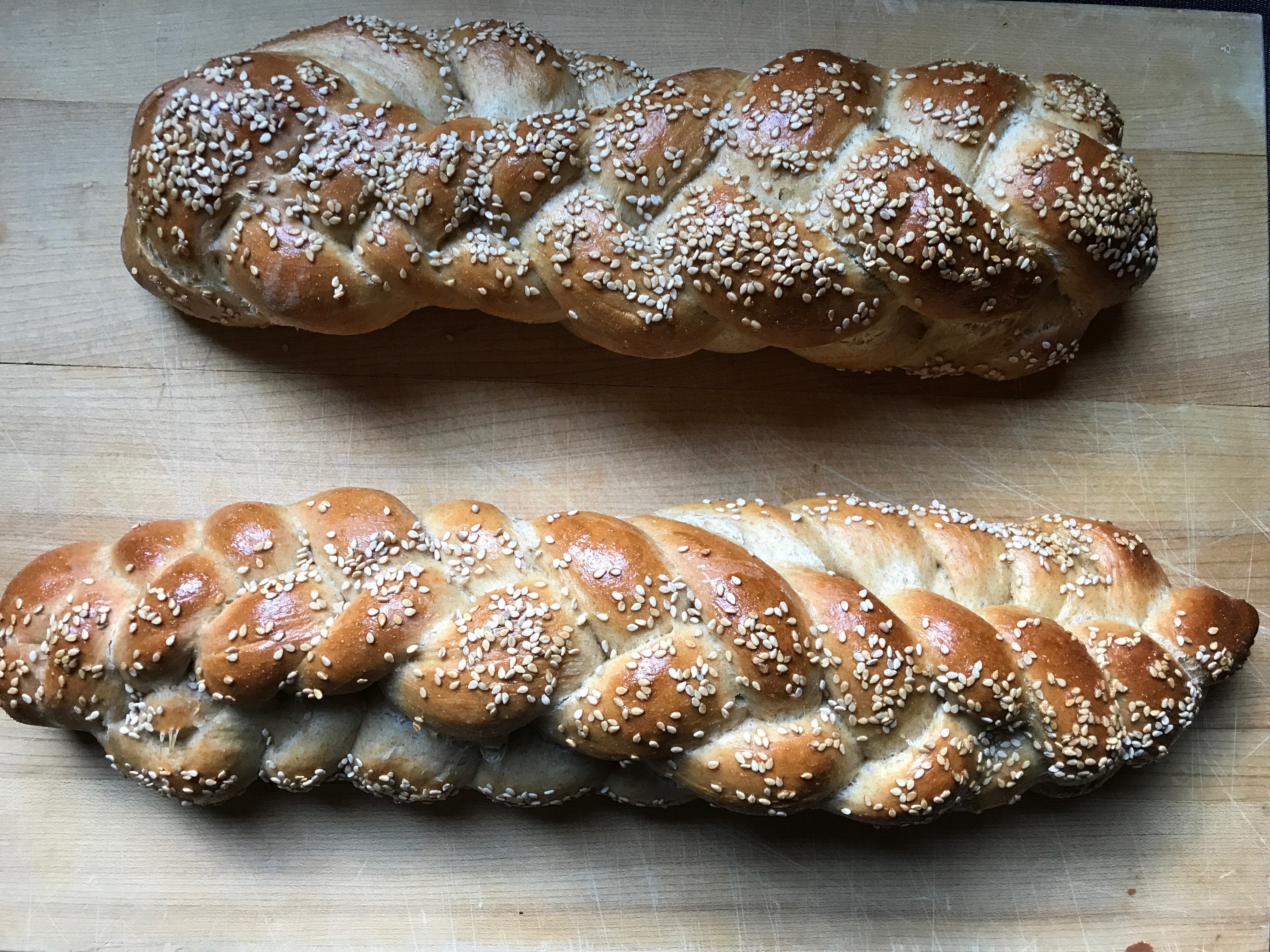
1847 Challah, Sponge Technique
Despite the name, this challah recipe doesn’t date back to 1847. I created it recently to feature 1847’s Red Fife and Daily Grind, but both of these whole grain flours can be substituted with other brands.
Sponge
2 cups warm milk
4 eggs lightly beaten
¼ cup honey
9 oz/2 cups 1847 Red Fife
4.8 oz/ 1 cup PC Organic All purpose, unbleached flour
1 tsp instant yeast
Final Dough
¼ cup melted unsalted butter
.6 oz/1 TBS salt
10 oz 1847 Daily Grind (whole grain multi-purpose flour)
12 oz PC Organic All purpose, unbleached flour
1 egg, beaten
¼ cup sesame seeds
Combine all the Sponge ingredients in the bowl of a KitchenAid mixer using the paddle attachment until just mixed. Cover and leave at room temperature for 2 hrs or until the surface is covered with small holes, just like a sponge.
Add butter, salt, Daily Grind and all-purpose flour to the sponge. Using a dough hook, mix for 8 min or until the dough balls up around the hook. Add a tablespoon or two of flour during the last 2 min of the mix if the dough is not pulling away from the sides of the bowl.
Transfer to an oiled plastic bin with cover for a bulk ferment (or proof) of 2hrs. (Alternately, slow down the ferment and put it in the fridge overnight for 8-12 hrs)
Line two baking sheets with parchment. Place the room temperature or refrigerated dough on a lightly floured surface. Use a dough scraper to cut in half. Cut each half into thirds. Roll out each piece to create six long ropes. Make two simple braids with three strands each and place on baking sheets. Cover with a clean dish towel or oiled plastic wrap and let rise for 1 hour or until doubled in size.
Bake in a preheated 350 F oven for 25-30 min or until internal temperature reaches 190 F



 Mado Food