Pesto Perfect

It’s August and I’m dipping fingers and bread into a bowl of freshly made pesto. The colour shimmers emerald green and licorice notes of sweet basil jump into my nostrils, the garlic-tinged oil making a smooth slide down my throat.

IMG_4022I want to eat it by the spoonful, but instead rush to store it before the colour and flavor are ruined by oxidization. So off it goes, portioned into small, glass jars covered by a thick layer of oil, lidded and refrigerated. I will slather it on warm toast, piling on sliced garden tomatoes and crisp bacon to make daily BLTs to be consumed with lascivious abandon. A teaspoon or two will find its way into homemade salad dressings, more will be drizzled over grilled shrimp and sometimes I’ll float a coin-sized island of it in the middle of a creamy cold cucumber soup or smear it on crostini with grilled veggies.

Continue reading “Pesto Perfect”

Becoming a San Francisco Baker, Part 2

By day two of Artisan Bread Baking Level III, I had a hunch: The cards just weren’t stacked in my team’s favour. Sure, we looked the part.Team 3 wore white chef’s coats buttoned to the collar with crisp, starched aprons secured at the waist. We clutched the same roll of formula-printouts in our hands as we entered the production facility. Just as the others, we plopped down our pens, smartphones and water bottles on our workbench and had access to the same high tech mixers and ovens. But there was no doubt about it: Team 3 lacked a certain, shall I say, je ne sais quoi.

Me and my mixer.
Me and my mixer.

Didier tried to be diplomatic but I know he knew what I knew, even before I knew it.

It was called experience.

The pros in our class knew exactly how to operate the second they stepped into the spotless bakery. But for us rookies, it was our first swing up at the bat in the big leagues.
Worse still, the real bakers knew that time was of the essence. They circled around the large room and took a mental log of where all the important stuff lived, like tubs and cylinders used to scale ingredients or hold fermenting dough. They instantly sourced out the Essential Four (flour, water, yeast and salt) and understood that all the water had to be cycled through a digital cooler then laboriously calibrated with a probe thermometer.IMG_2828_EDIT From the corner of my eye, I saw a flurry of activity, bakers racing by our workbench wielding tall, plastic stacks of containers, pulling bins-on-wheels full of flour and figuring out which scales worked and which didn’t.

But my team was just too busy standing still, staring at each other’s nametags and politely pointing at the pile of formulas and wondering which of us would lead our naïve flock.

It was Chef Jesus, of course.

But how would I possibly address this tall, broad-shouldered teammate who stood by my side, yet towered above me? Should I pronounce the name embroidered on his chef’s coat like Sunday school or offer up a Spanishy “Hey Seuss? When I mangled out the latter, a cringe swept over the Texan’s mug then Jesus Lugo calmly inhaled, looked me straight in the eye and said dead-pan, “That’s right, Madeleine.”

From then on, I knew our team had an inkling of a chance. Not only was Chef Jesus Lugo experienced, but an extremely patient man who just happened to be built like a Mack truck. A community college instructor from El Paso, Texas, Jesus took the bull by the horns and picked up (no, levitated) a 20-kilo pail full of poolish and deftly poured it into the VMI Phebus mixer near our workbench.

IMG_2799_EDIT
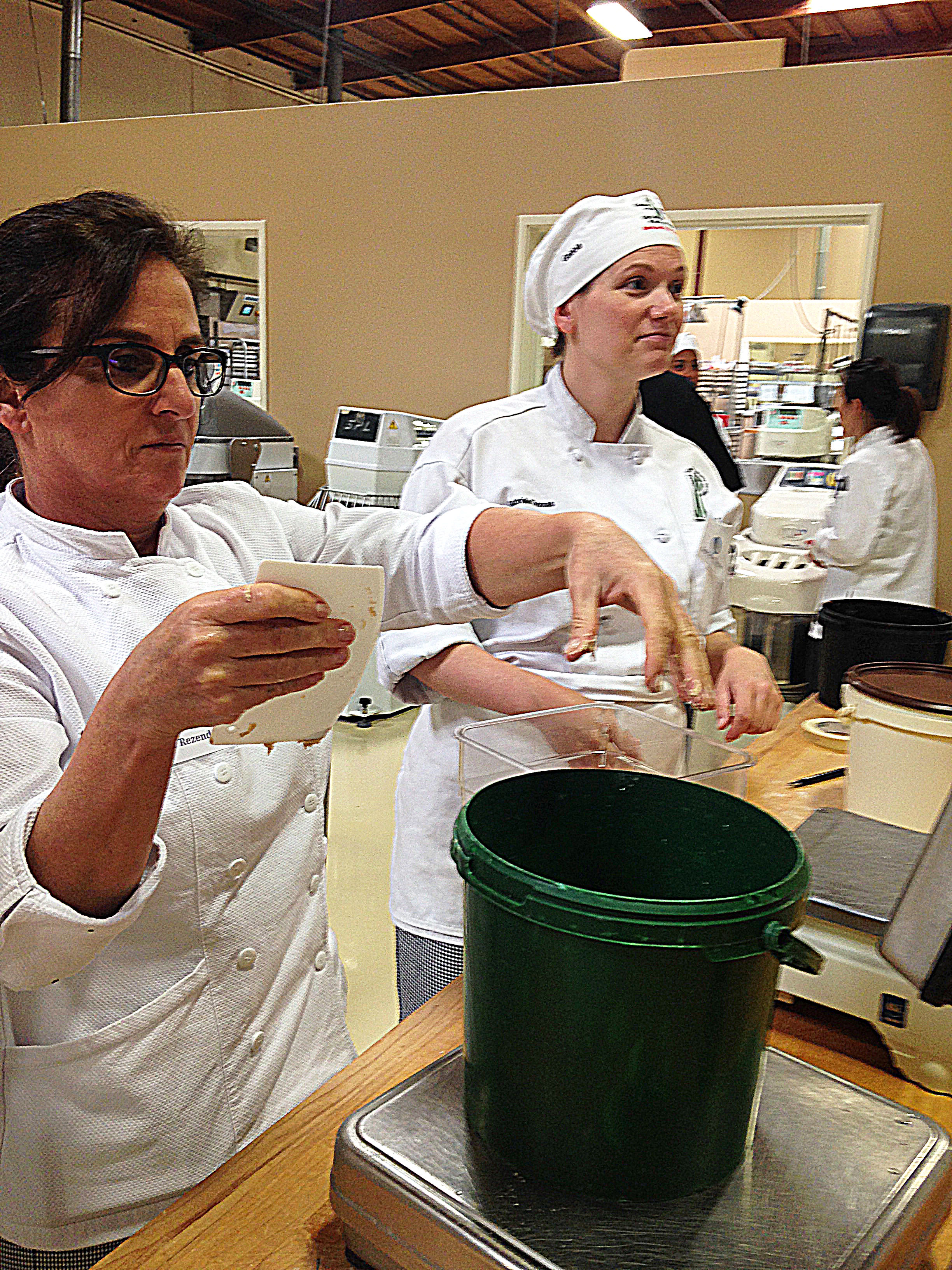
L to R: Teammates Claudia Rezende and Gabrielle Thomas

Meanwhile, Claudia Rezende from Sao Paolo was scaling flour, reading glasses perched halfway down her nose, bouncing kid-like on her tiptoes in order to see the digital numbers flashing in front to her. She was giddy with joy to be standing in this facility in South San Francisco. Like I, she’d booked a room at a nearby airport motel and was titillated to be honing professional skills. But after less than a minute at the scale, Claudia stamped her foot angrily and swore something completely unsterile in Portuguese. One huge scoop of flour had just tipped the scale and the digital readout had gone blank.
IMG_3030_EDIT
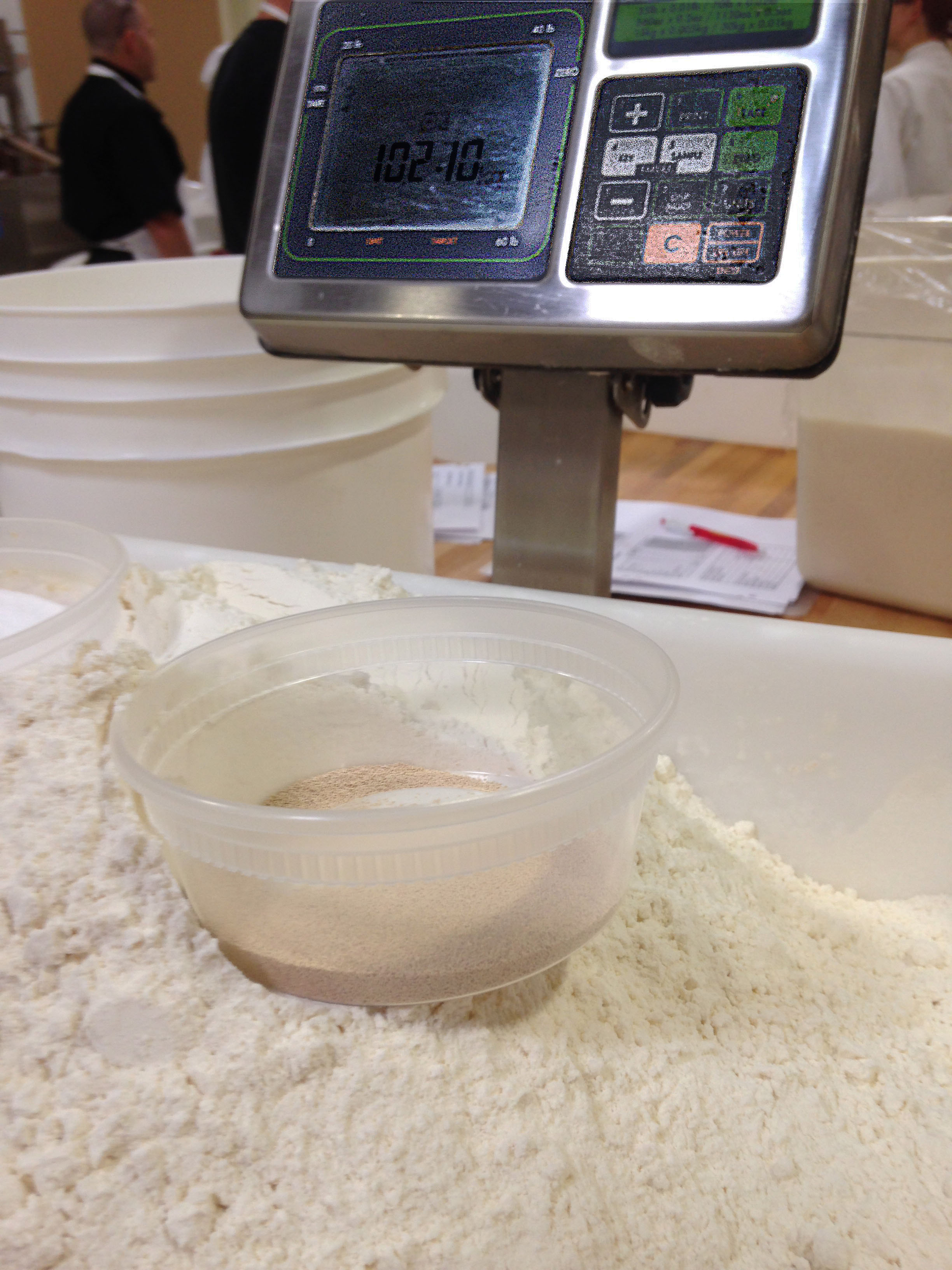
Scaled yeast in a container on top of scaled flour.

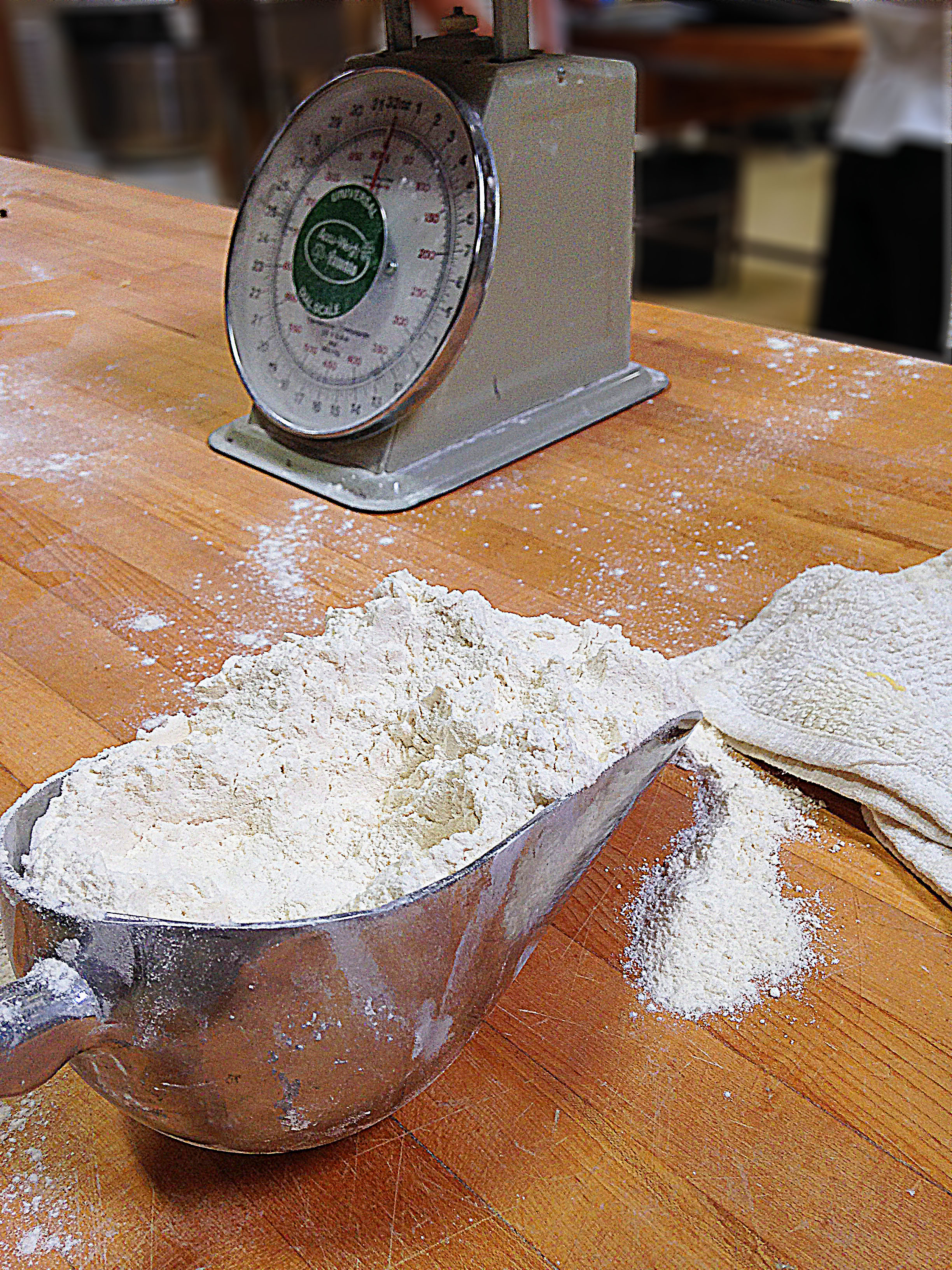
Bread is baked by weight not volume and bakers follow formulas, not recipes. On day two of the course, we would bake four different breads: semolina durIMG_3270_EDITum crowns, rustic filone, spelt bread and 100 % whole grain bread. Every bread formula was designed to produce 25-40 kilos of dough (enough to cover the surface of a bath tub like a big, fluffy pillow) and would bake off into 50-75 loaves.

Everything was weighed.

On average, every one of Didier’s formulas was based on 10 kilos of flour. I’ve watched Toronto bakers slash open humungous 10-kilo-bags of flour mix, dump the entire contents into a mammoth mixer, pour in litres of water by the pitcher-full then turn on the mixers’ timer and walk away.

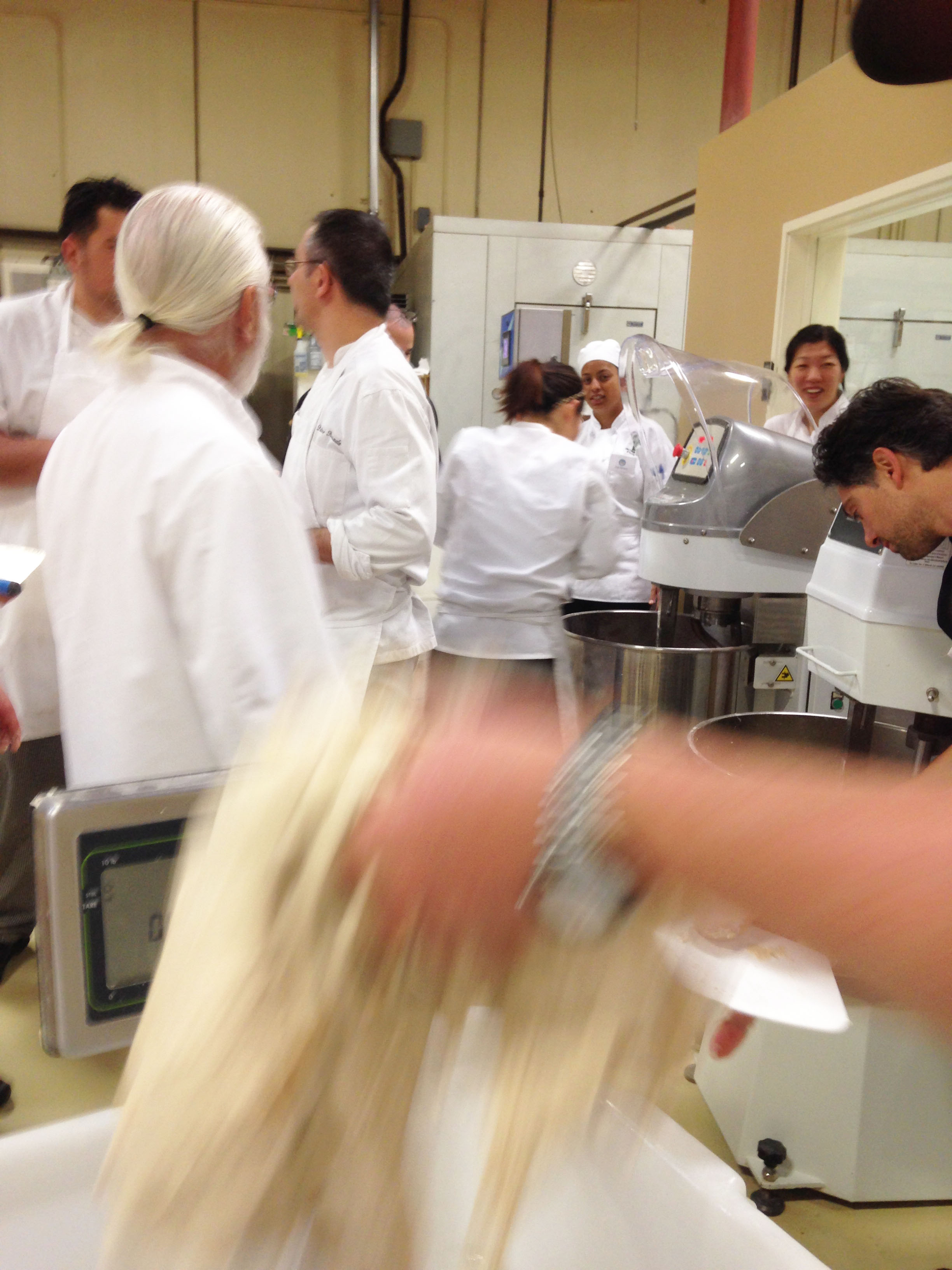
Not us. At SFBI we were “in production” in a refined, complex, scientific and artisanal way. Thus, the semolina durum crowns we mixed up on Day Two required 10 kilos of hard, white bread flour but our job was to meticulously scale (baker-speak for weigh out) this flour into a large, plastic rectangular bin, haul and dump it into a mixing bowl the size of a jumbo exercise ball, then add two (not one!) pre-ferments: a whole wheat durum sponge and a durum semolina poolish that had been prepared the day before and left to ferment from sundown to sunrise.IMG_3035_EDIT

“The pre-ferment!” shouted out Didier in the classroom the day before, his pitch just shrill enough to wake anyone snoozing in the back. “This is our secret tool. We can add something, something so fantastic to the final dough with a pre-ferment. What do you think that is?” he asked, his tone rising on the last syllable and left hanging in the air. He stared at us expectantly for a long while until he couldn’t stand it anymore and teased up the air above us, pointing and waving his magic marker frantically.

“Uh, uh, more fermentation?” suggested someone as if risen out of a coma.

“Yes, so….?” he prodded and waited, the room growing loud with silence until he sang out “Flavor my friends, flaaaaaavorrrr!!!” he droned with religious fervor.

But of course.

To be continued

IMG_3468_EDIT_Banner

Becoming a San Francisco Baker, Part 1

I am a happy baker but a very reluctant scientist. Certain that I could pump up one of my greatest passions with some technical muscle, I recently enrolled in the five-day Artisan III Advanced Bread course offered at the San Francisco Baking Institute.

I chose the course somewhat illogically. I wanted a challenge and knew that most of the scientific baking terms outlined in day one of the curriculum were an utter mystery to my blonde brain: IMG_2815_editwhether it was interpretative flour terminology like ash content or falling number or fermenting fundamentals like knowing your acetic acid from your lactic, the truth was it would all come in handy if I ever wanted to get totally serious about bread and open a bakery – which I don’t.

IMG_2793_edit
Didier Rosada

But I like to dream that I might… and even our instructor, certified Master Baker Didier Rosada was prone to talking at length about romance and passion as any fine, French born and trained professional might when lapsing into a reverie about all things gastronomique.

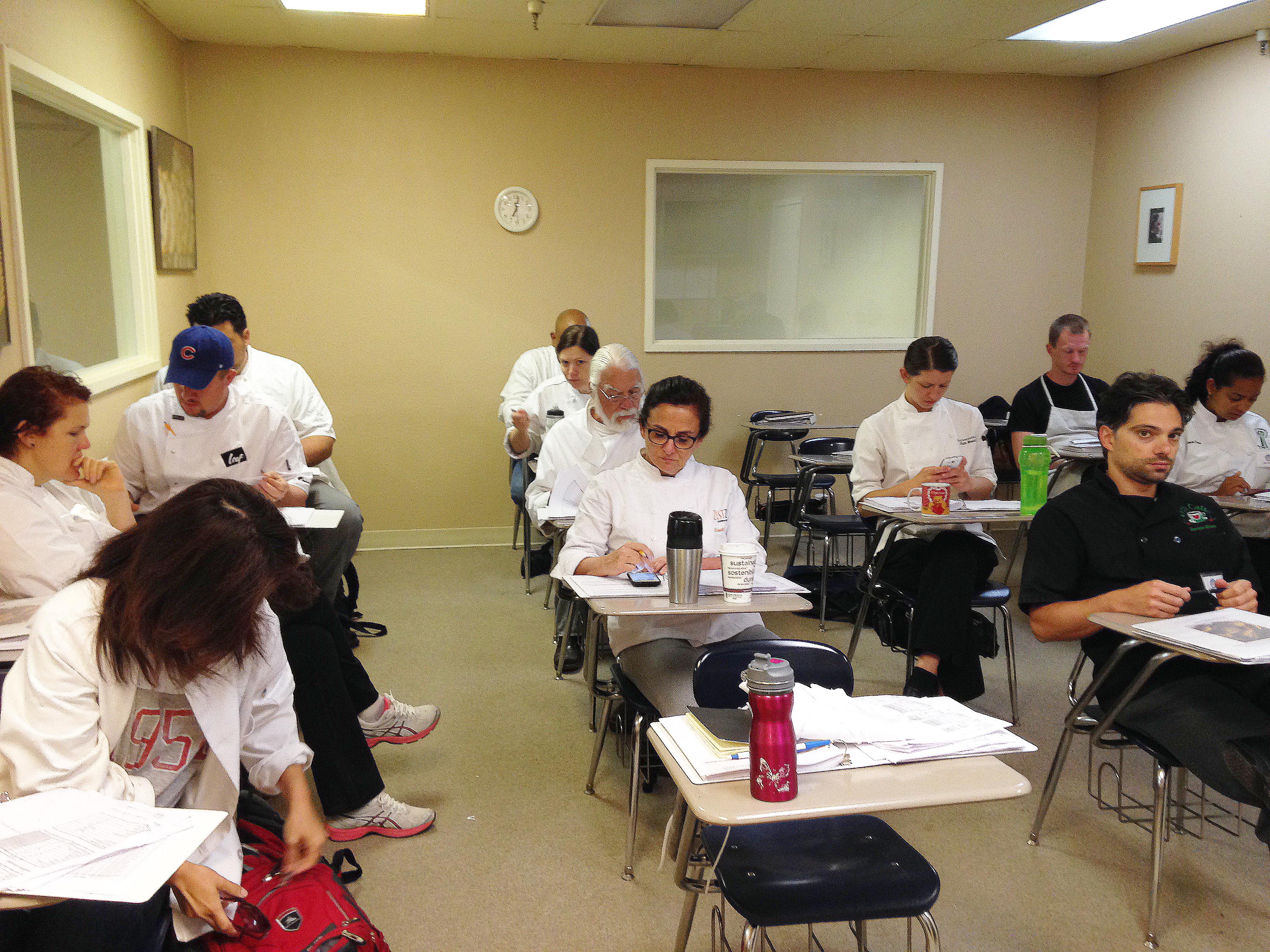
Bread, despite its lowly origins and simple ingredients, had captivated 18 adult students enough to willingly sit behind cramped little desks in a fluorescent-lit-classroom for six long hours on that first day before we even came within a nose of inhaling the toasty, rich aromas of blistery crusts baking in the eight-deck, 200-loaf- capacity behemoth oven downstairs.

IMG_3246_editWe came from all corners of the world, we students of flour, water, yeast and salt, with a dozen different accents among us. Every so often, the instructor would speak of “yeast going dormant” or “dough conditioners” and questions in all different accents would pop up like mushrooms making for a broken telephone of misunderstanding interpreted in South African, New Zealand, Italian, Japanese or Brazilan-accented English.

Two bakery owners came from the far reaches of Johannesburg and Auckland to assess the week’s training, considering whether it was worth the expense to ship their staff to San Francisco for a week or two of bread school. Another two students, both recent San Francisco city college baking program grads, came for post-grad detailing while I belonged to the ‘serious home bakers’ faction which included a mother of teens from Sao Paolo, Brazil and a French history professor from Oklahoma. An exclusive Utah grocery chain sent two employees to finesse their ciabatta and baguette skills while Urth Caffé of Los Angeles dispatched two of their executive chefs.IMG_2954_edit

Big dollars were riding on many of the bread brains in the room and our leader, Didier often rolled his eyes upward in obeisance to the food gods as he rolled his r’s dramatically and proclaimed in his thick, French accent the defining hallmark of the course, “Production!” which is industry-speak for — well, baking.

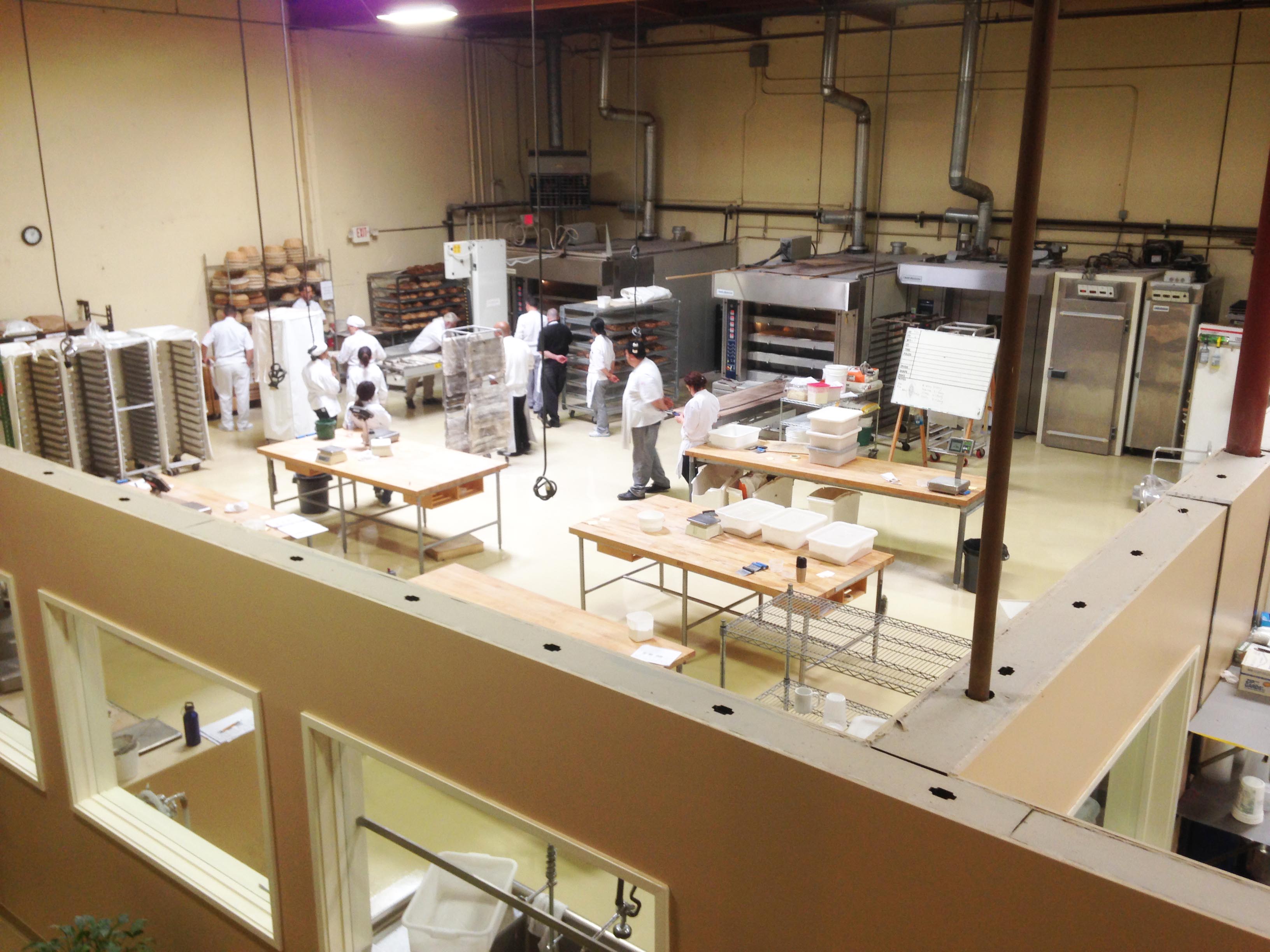
Enter the contradiction. We were enrolled to learn artisanal techniques in an industrial, high tech environment. The institute is situated under the same roof as TMB Baking, a distributor of baking equipment from around the globe. Imagine an airport hangar divided into three separate bakeries (two used as bakery/classrooms, the other a commercial off-site bakery for SFBI’s two,

IMG_3498_edit2

downtown retail stores) beside an equally vast area housing bakery equipment stock. I liked to linger outside our second floor classroom, perch on the balcony and take in an eagle eyes’ view of the high-energy production facilities below.

“Only 20 % of baking in the USA is artisanal, “declared Didier on our first day, explaining that the remaining 80 percent is of the more commercial variety, namely pan loaves and bun production. Think baguette versus Wonderbread, ciabatta versus Kaiser rolls. IMG_3184_editArtisanal is based on traditional, Old World techniques compared to high quantity, fast and industrial modern bread baking. Yet, enter the word “production” and we are talking about large-scale baking of old school recipes.

After five hours of classroom science on the first day of the program, I was chomping at the bit to get my artisanal hands into flour and start production.   Didier pointed at me and four other students in the same row of desks and declared with his usual flourish: “You five are team Number 3!”

He then scribbled a haze of weights, team numbers and formulas on the white board and suddenly it was time to get out from under our school desks and into the production lab . I detected a certain hop and vigor in everyone’s descent down the stairs. In the next hour, we would prepare vats of rye and spelt polish, durum sponge and whole wheat levain that would ferment and bubble all night long until our return for Day Two.

To be continuedIMG_3042_edit

Stop right now, thank you very much

Lately I’ve been feeling out-of-touch with the trendsetters of Toronto’s vibrant food scene. But just a few nights ago, I spent several delicious hours updating my internal food app at The Stop Night Market. I even stood in line – despite my well-known personal aversion to this urban predilection.IMG_2660

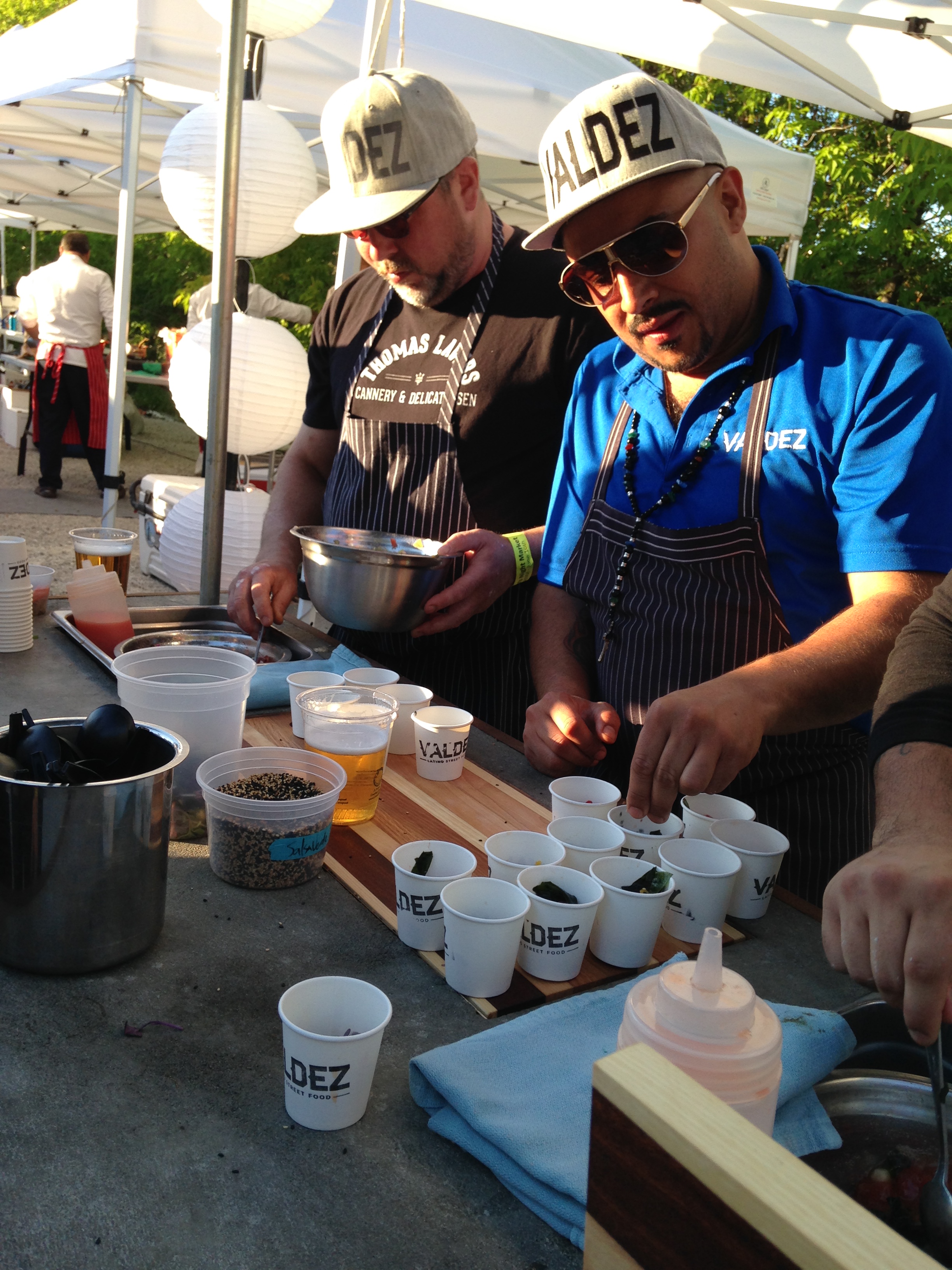
I joined a thousand other ticket holders entering the vast, empty lot at 181 Sterling Road in Toronto’s west end and felt a gentle thrill as every line moved at a painless, carefree pace. It didn’t hurt that the evening was bathed in a warm, golden June light that put a glow on everything and everyone, including my neon yellow wristband – an all-you-can-eat ticket to sample from 47 unique food and beverage carts manned by many of Toronto’s food celebs from Momofuko Shoto to up-and-coming stars like Rasa, Branca, Dailo and Boralia .

I was ready to brave the mission alone but was happily joined by yoga-buddy, neighbour and CBC radio host Gill Deacon who tapped my shoulder hello and offered to cart-cruise with me. IMG_2655We ambled up to a counter and found ourselves spooning up esquites or messy mouthfuls of creamy, cheesy smoked white corn spiked with chillies and lime juice. Gabriela Ituarta of Maizal explained that we weren’t eating your average peaches ‘n cream corn but an heirloom white variety grown sustainably in the Kawarthas alongside blue, black and green corns.

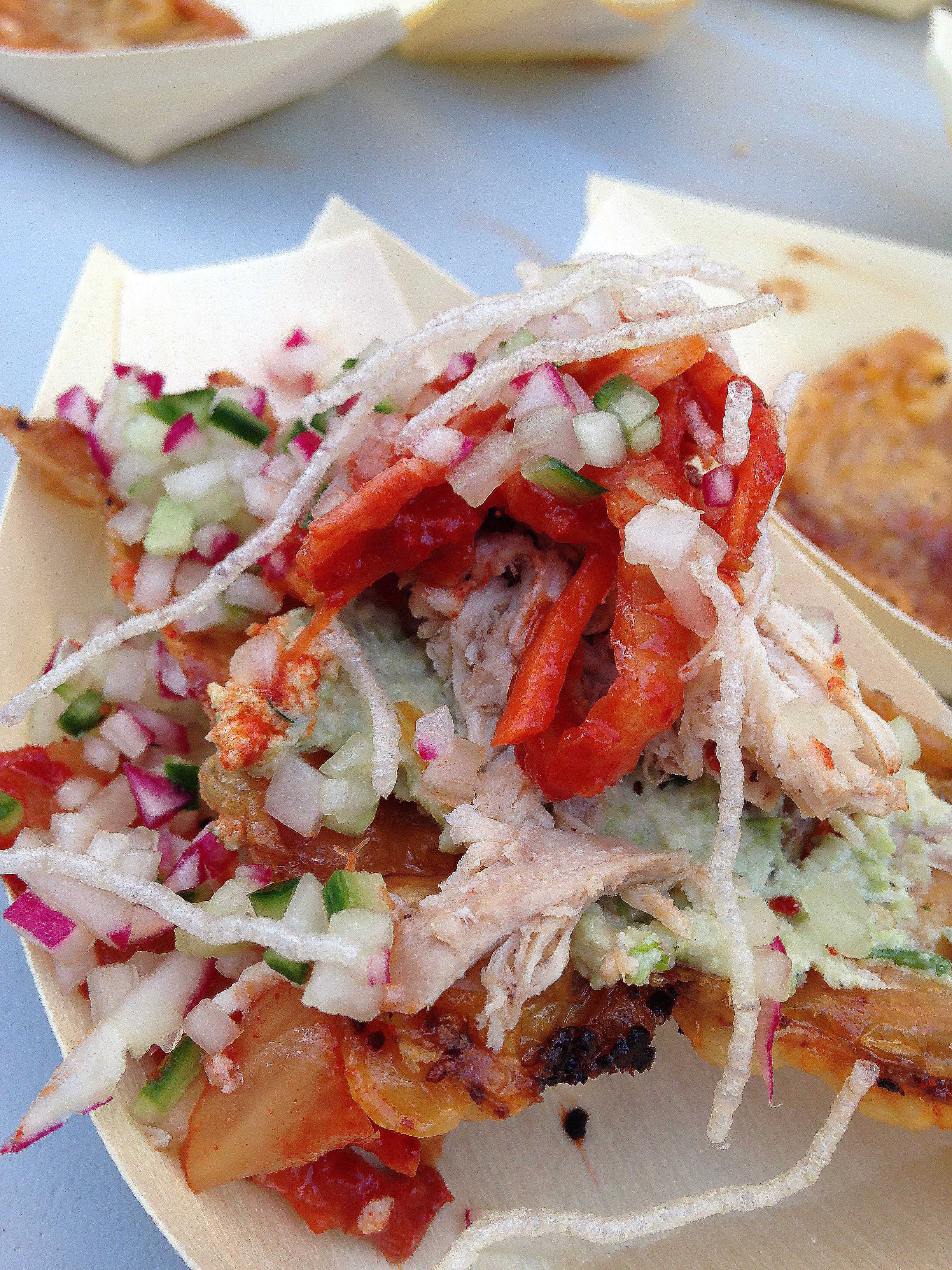
Two carts away, the aroma of Hawthorne’s signature dish beckoned: crispy chicken skin tacosIMG_2702 piled high with braised chicken, carrot kimchi, flash-fried vermicelli and guacamole edamame (I dare you to say that three times). Gill and I kicked back our sliders in mere seconds, delighting in these unctuous, texturally divine creations.

IMG_2668_edit
Crispy Chicken Skin Tacos

Next stop, Dailo and chef Nick Liu’s large, welcoming platter of locally produced smoked trout served on delicate betel leaves, covered in a toss of kaffir lime leaves, hot Thai peppers and coriander. Commonly used throughout Asia to wrap around highly addictive chewable betel nuts, these leaves are rarely found on the plate, yet they’re surprisingly sweet, tender and thin, providing the perfect vehicle for a sampler.

IMG_2680_edit
Smoked trout on betel leaf with satay almond sauce and fried shallots

Unlike many of the Night Market offerings, Dailo’s betel leaf preparation was a one-bite morsel that suited my mission to taste widely yet wisely. Night market feeding is a bit like binging on Netflix. You don’t want to stop. The pull of eye candy is immense. Yet the overwhelm factor easily sets in. Besides, the host of the event, The Stop, is all about food consciousness.

IMG_2675_edit
KanPai red rice, barbecue pork and lotus root

According to Kathe Rogers of The Stop, this two-night event raised $200,000 to help “fight hunger, build hope and inspire change” and sponsors such as Blue Goose (naturally raised beef, fish and chicken), Fiesta Farms, and Boulart (artisanal bread) donated raw materials to these restaurant teams that worked like mad to pump out 800 samples in a single evening.

Eavesdropping at the AGO cart, I could detect a slaphappy, Red Bull induced banter   among the half dozen chefs scrambling to keep the Pan American Tamale Stand operating smoothly. Yet despite the crowds and the unceasing need-to-feed, executive sous Chef Renée Bellefeuille had plenty of time to share recipes and enjoy accolades from fellow eaters.

IMG_2697“Do not eat the corn husk,” laughed one of the chefs as I dove into smoked chicken with caramelized onions, charred corn and queso rolled inside a steamed cornmeal cake that sky-rocketed from delicious to miraculous once doused with dollops of salsa verde , cherry tomato salsa and lime crema.

“Cholulu, don’t forget the cholulu. It’s my favourite,” said Renée, when she saw me lingering at the high-traffic condiment station.

IMG_2700_editShe also noticed that I took only one heavenly nibble of her dessert tamale with its rum soaked pineapple and caramel rivers of dulce de leche spooned over a sweet, steamy masa harina.

But pacing, my friends, is the only answer to a night market feast especially when the sun starts to set, samples get lost in the shadows and chefs lose their happy-to-serve-you mojo.

Hail to sales people.

Marketing Meredith at Libretto Pizzeria was still revved up enough at sunset to provide a full introduction to frittatina, or stuffed bucatini pasta that inexplicably transformed into square cubes once tossed into the deep-fryer! They emerge with a creamy hot interior of provolone and bechamel sauce beneath a lightly battered surface. Dunked into tomato sauce, these addictive creatures are a hallmark of Libretto’s newest resto concept, A3 on College Street.

IMG_2714_edit
A3’s Frittatina

Learn something new every day.

And when you get to taste it all amid one thousand other happy campers, it is a win-win.

Thank you, The Stop.


The rub on spices

Decades ago, I warned Toronto Star readers in my “Taste of Asia” column to throw out any ground spices and herbs in their cupboards older than six months. I said they were past their prime. Defunct. Bad stuff.

No one likes a bossy food writer, so I tried to soften the tone and replace visions of global spice carnage with a gentle challenge: Close your eyes, open a random bottle and take a whiff.IMG_2593

“If you can’t smell anything, toss it,” I cajoled.

Well, I’m still on a spice rant after all these years. Commercially dried and ground spices and herbs lose most of their je ne sais quoi the moment they are harvested and processed, for it is at this juncture that their flavour-filled essential oils begin to degrade.

It gets worse.

When herbs and spices are ground into a powder, they are exposed to the ravages of oxidization and time… especially if they fall into obscurity in a deranged spice drawer like mine.

Luckily, mine underwent a radical makeover last week. I threw out all the wizened and yellowed dried red peppers, aroma-less ground powders of dubious distinction and the contents of any package, bottle or tin box that landed in said drawer prior to 2015 – with the exception of nutmeg.IMG_2545

I’m the proud owner of some relatively ancient nutmeg nuts, encased in shells and decorated with a fancy filament of mace. They come from Grenada and I began to horde them after several culinary visits to the Spice Island of the Caribbean. Alas, these nutmegs have broken all my self-imposed “Spice and Herb Guidelines”. They demonstrate incredible flavour once I hack off the shell with the blunt end of a knife and finely grate with my Cuisipro rasp.IMG_2586

The places this nutmeg goes! Sometimes it’s just a sprinkle over a Grenada-style rum punch. Or, a teaspoon into garam masala bound for a Punjabi-style curry. So alive are my nutmeg relics that a taster at my table recently detected a single smidgen slipped into a creamy, rich Yukon gold potato gratin.

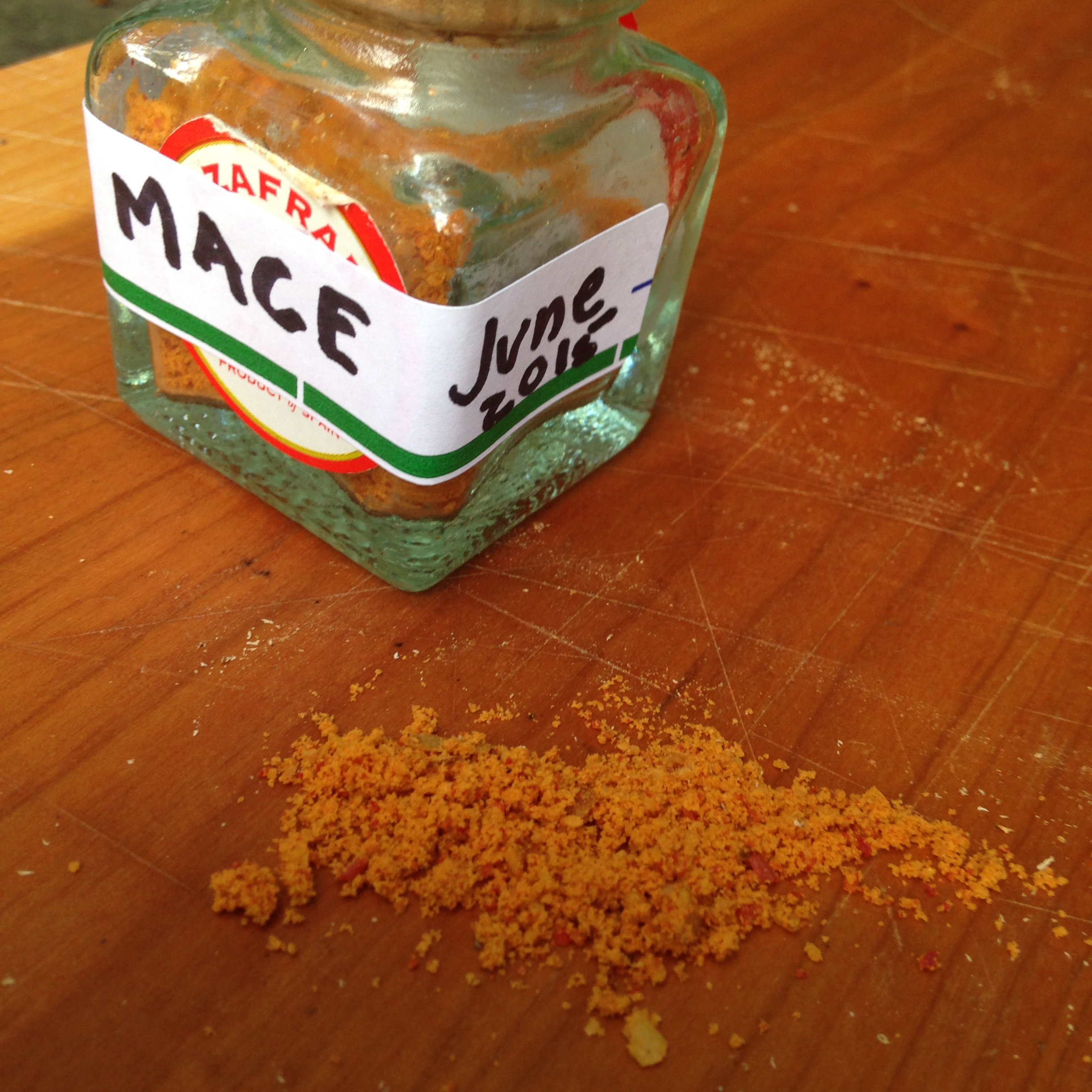
Despite an undeniably close connection to the ever-popular nutmeg, mace is one loner of a spice. It boasts a well-known affinity with pumpkin, but just doesn’t seem to pop up on the recipe radar otherwise. You can imagine my glee, when I stumbled on a rub recipe calling for a whopping teaspoon of the stuff. I had some whole mace at my fingertips and was ready to put it through the grinder.

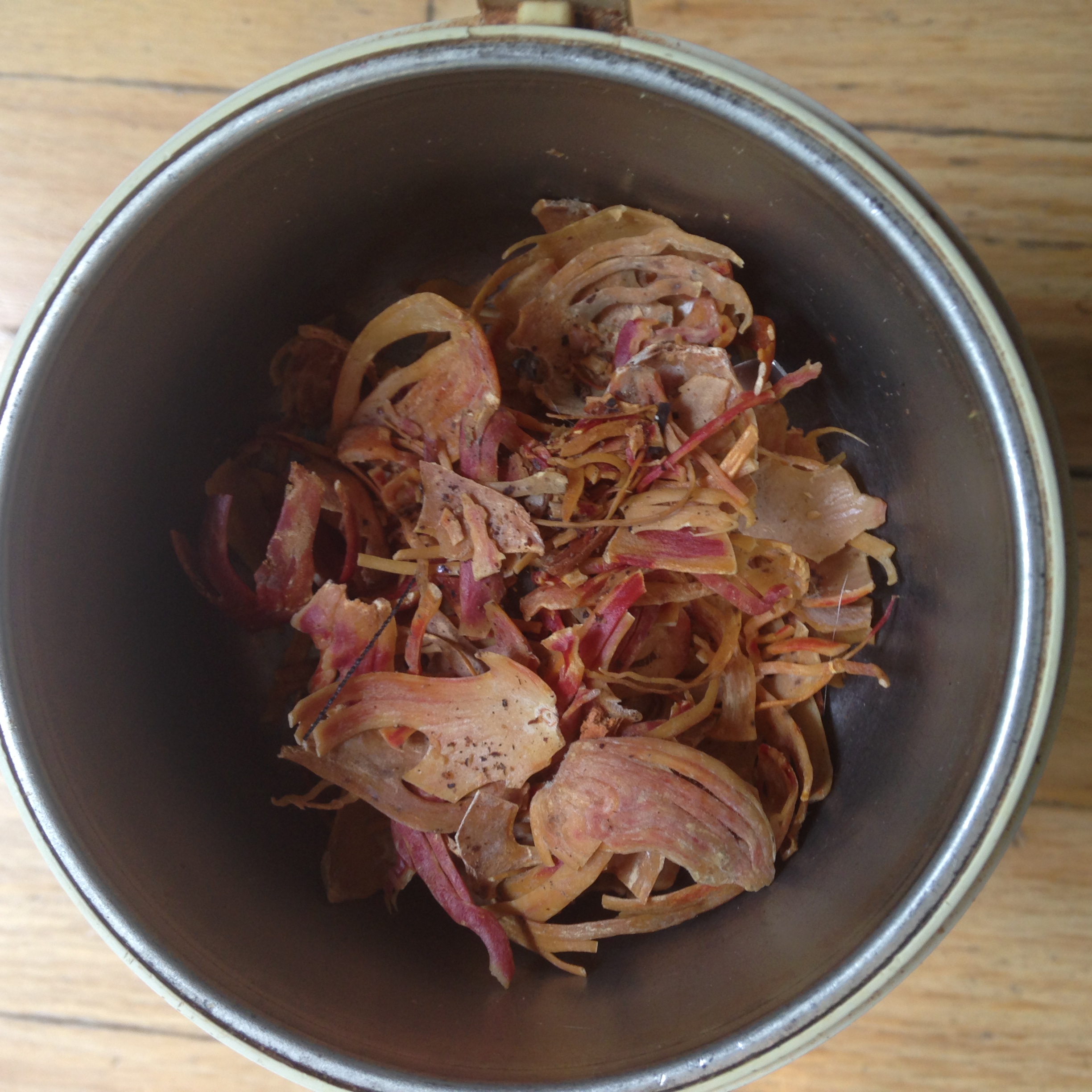
IMG_2545I simply peeled the lacy filaments off my whole nutmegs and placed them in my trusty spice blender that has continued to get revved up over all the cumin, cinnamon, cloves, cardamom (green and black), peppercorns, hot peppers, coriander, all spice, fennel and fenugreek I have been feeding it for the past three decades.

In went the mace filaments and out came a surprisingly pumpkin-toned powder that tasted more pungent and citrusy than its soul-sister nutmeg. When I closed my eyes and did a side-by-side sniff of the two, it was difficult to tell them apart. No wonder McCormick spice’s web site suggests putting either one in many of the same destinations, be it custards, eggnog, spice-filled quick breads or dusted on steamed veggies like carrots or sugar snap peas.IMG_2546IMG_2550

Back to the rub, which I spotted in my beloved Joy of Cooking but as per usual, put my own riff on. I chose it not only for the mace, but all the roasted cumin and cracked peppercorns.

Admittedly, cumin is my favourite. Sometimes I grind it raw, but I’m more apt to first toast the seeds in a dry frying pan over medium heat until they start to smoke. (Dry-frying spices is a risky venture as there’s a fine line between browning and burning. It helps to keep a sample of raw cumin seeds nearby as you dry-fry, to offer a visual comparison.) I like to grind the cumin seeds while they’re hot so as to savour the hot cloud of nutty cumin smoke released when the lid comes off.

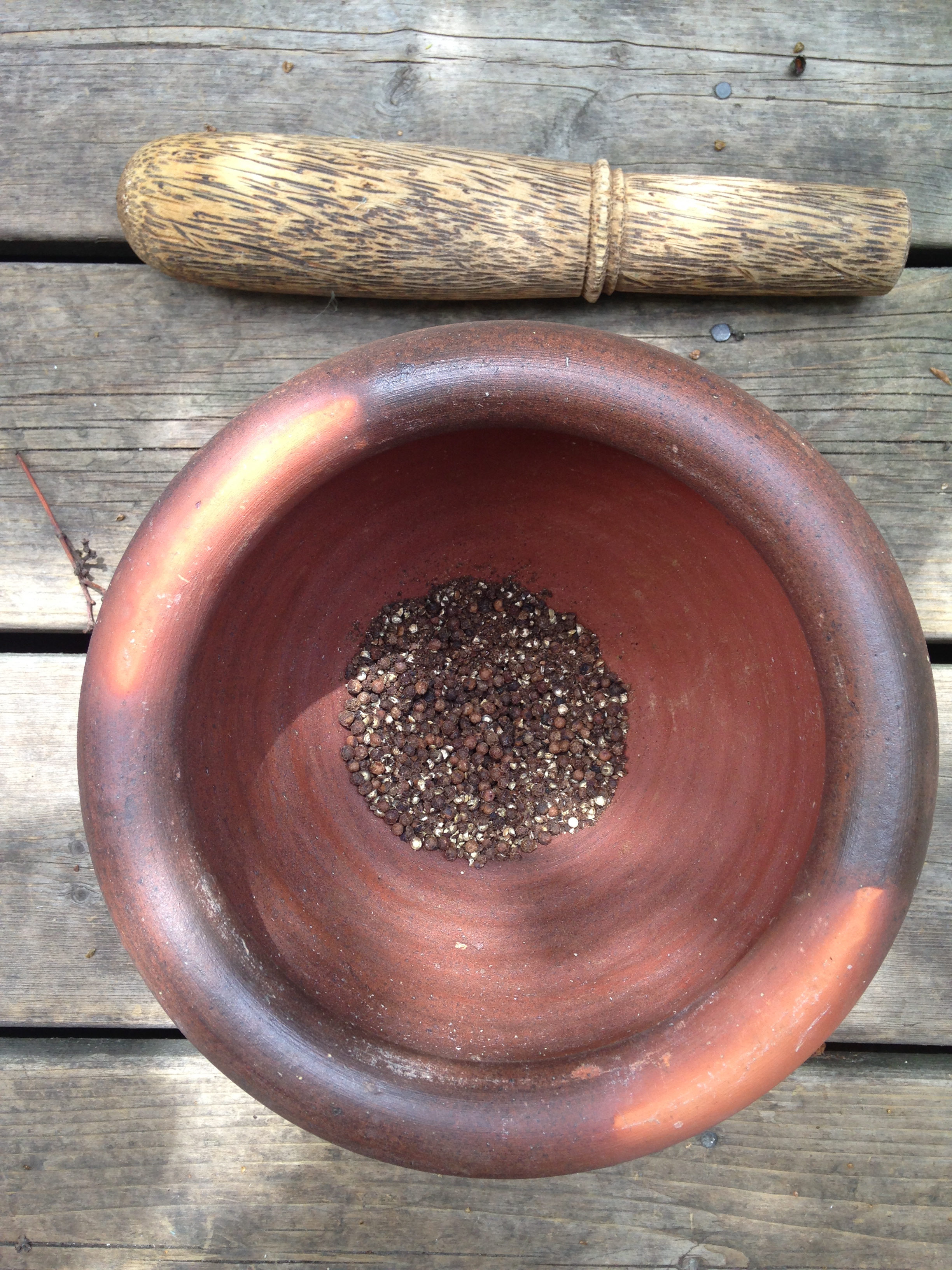
IMG_2554I used my Thai mortar and pestle to crack or coarsely grind the black peppercorns used in this rub. To add authenticity, I took my hulking mortar outside, placed it on my back deck and visualized the northern Thai town of Fang where I saw countless fine cooks squat and pound – a satisfying way to approach this kitchen tool and more effective than placing it on a kitchen counter.

IMG_2542

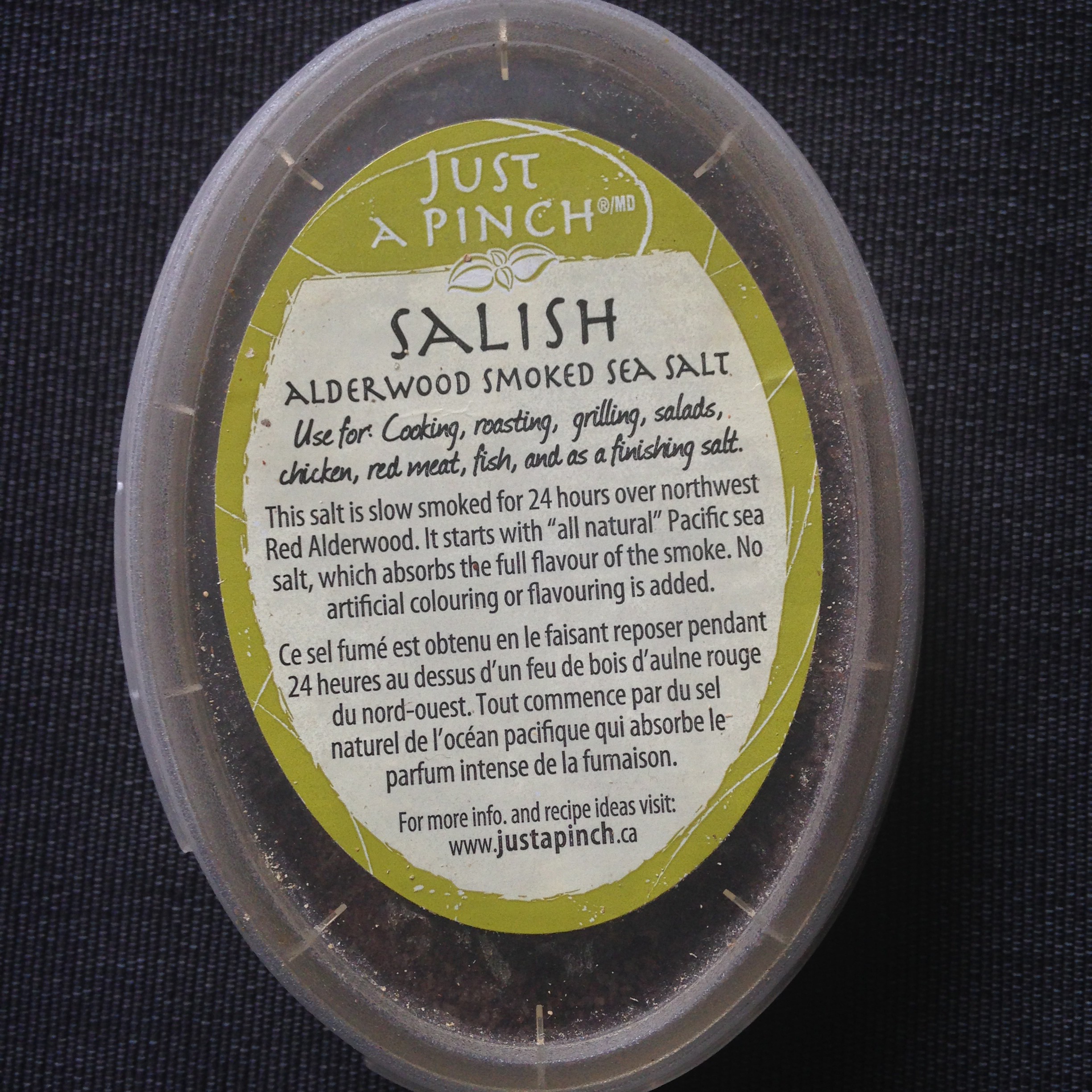
Last but not least, salt. If you like smoky flavours, check out Salish, an Alderwood smoked sea salt.


Smokey, toasty pork rub

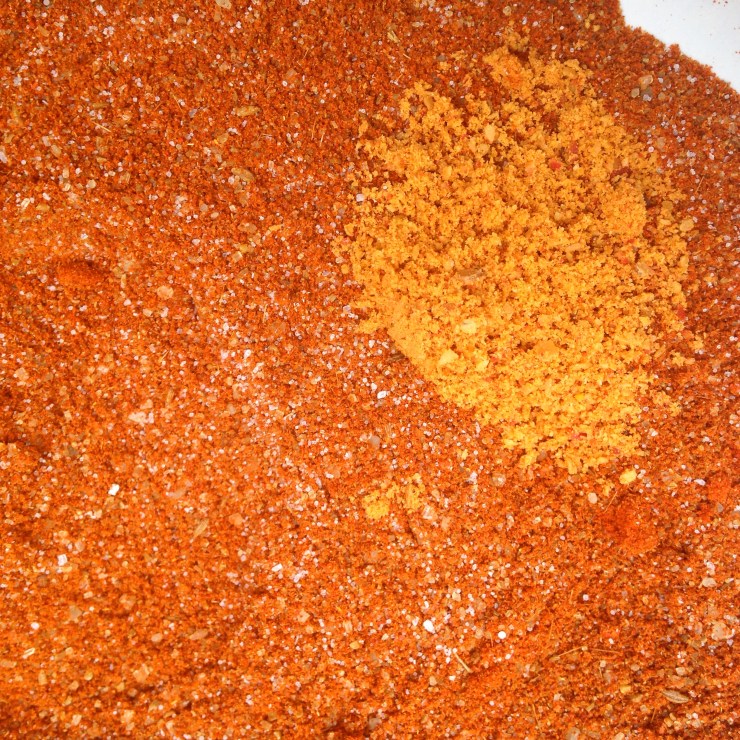
Get out your spice grinder and have some fun concocting this gorgeous mixture. Whole nutmeg nuts can be found in Kensington or St Lawrence Market or Little India. Try this on grilled pork chops, baby back ribs or slow-cooked pork shoulder. Rub one tablespoon per pound just prior to cooking or better still, rub and refrigerate overnight.

½ cup sweet or smoked paprika

¼ cup ground roasted cumin

¼ cup packed brown sugar

¼ cup cracked/coarsely ground black peppers

2 tbsp hot cayenne powder

2 tbsp sea salt

1 tbsp chile guajillo molido (or any mild chile powder)

1 tbsp smoked salt

2 tsp mace

© 2015 Madeleine Greey

IMG_2564


My mango mania

I met my first mango in Taiwan in 1980 and it was love at first bite.  Like so much for me in Asia then, a mango was terribly exotic and new. I was floored by its fresh, juicy, tropical taste and loved eating it “inside out”,  those luscious orange cubes popping out from a leathery,  inverted skin.thai20ice

Mango orchards covered much of Taiwan and small mountains of these fruits used to fill the markets during mango season. On a student budget, this was something I could afford to binge on, but my Chinese Auntie was appalled by my ravenous appetite.

“Too much yang,” she’d scold, wagging a finger. “This fruit is too yang. It’s  too hot!  It’s going to make you sick.”

It didn’t.

I know that Chinese notions of dietary, yin-yang balance are centuries old and very wise but when mango season comes to town, I open wide and gobble up.

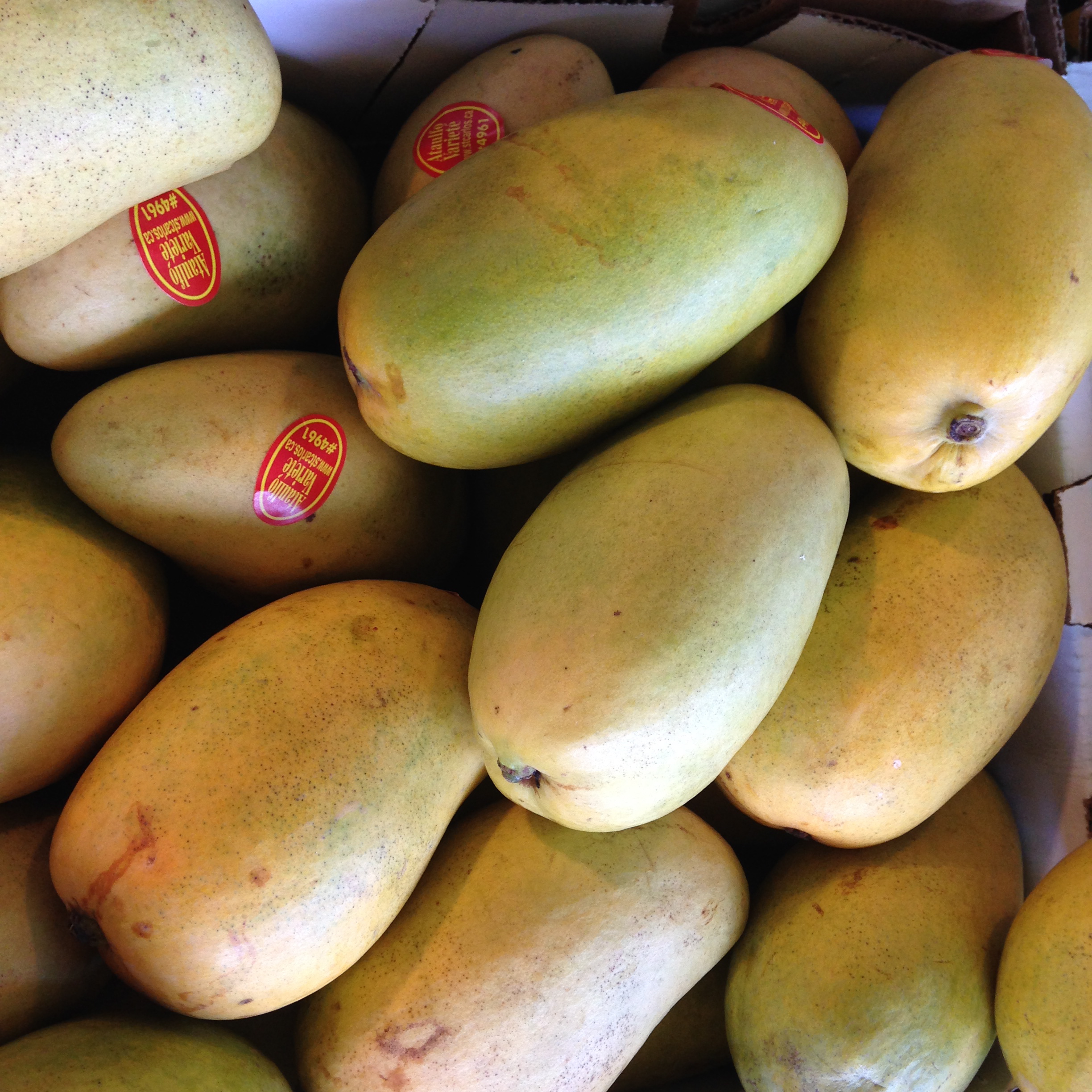
IMG_1704Every spring in Toronto these yellow, kidney-shaped mangoes called Ataulfo and Alphonso start to appear and I can’t wait to peel off their skin and slice into their rich golden, fibreless skin. Deeply sweet and intoxicating, it’s no wonder Persians named it samarbehist or fruit from heaven.

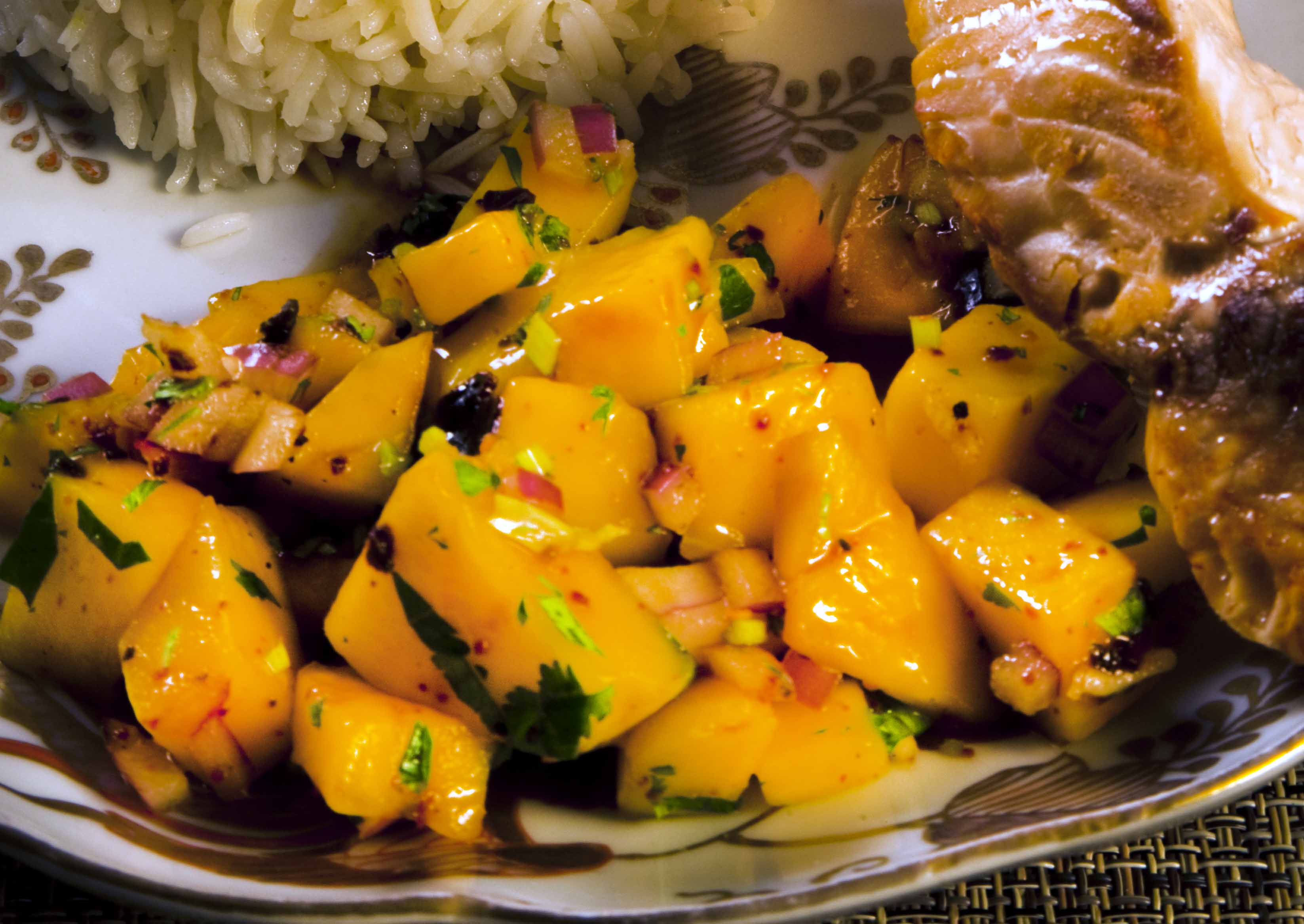
I’m happy to eat it straight for breakfast, or slice it up and toss it into a fruit or green leafy salad. It goes into my Thai mango salad and stars in a salsa (recipe below). Sometimes I’ll cook up some coconut sticky rice and serve that adorned with thin slices of mango. Nothing beats it pureed into a mango lassi or strawberry smoothie.

Besides rocking in the taste department, mango is a nutritional powerhouse, ranked right up there in the top ten list of good-for-you fruits. It’s an excellent source of vitamin A, high in C and a source of fibre, vitamins E and B6. Moreover, it’s bursting with carotenoids (plant pigments) such as beta carotene and zeaxanthin, which protect against cancer, enhance immunity and help to prevent age-related macular degeneration, the leading cause of blindness.

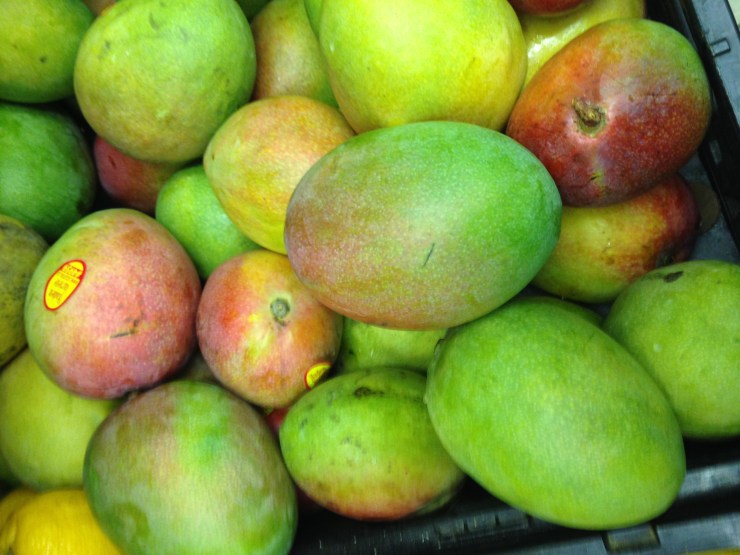
Before Ataulfo and Alphonso entered the market, most consumers were familiar with Haden, Kent or Tommy Atkins mango. These are oblong or roundish, about the size of an adult hand, covered in green skin splashed with red and sometimes yellow patches. They usually weigh about twice that of the smaller yellow ones.

IMG_1711It’s good to know that colouring does not indicate ripeness in a mango. How it feels, does. A ripe mango should yield to slight pressure and have the feel of good leather. Sniff around the stem end. A ripe mango will emit an intense, flowery smell.

Two new varieties of mango have become available, the big green Keitt from the USA and the Pango Mango from Puerto Rico. Both are large meaty mangoes. The Keitt stays green, even when ripe.   And the newly developed green Pango Mango with its reddish blush has no fibre at all.

MANGO SALSA

Serves 4

_MG_9552-EditEdit

This salsa offers up a quartet of flavours: sweet, sour, salty and hot. It’s a cinch to make and, like most salsas, the flavours intensify if you let it sit in the fridge for a few hours before serving. Mango salsa is the perfect counterpoint to grilled poultry or fish, Tex-Mex dishes or even curry served on rice. Be sure to use fully ripe mangoes.

2 ripe mangoes, peeled and diced into 1/4-1/2-inch cubes

1/2 cup            chopped red onion

1 clove garlic, crushed

1/4 cup            chopped fresh coriander

Juice of 1 +1/2 limes

2 roasted sweet peppers   * optional

1 large dried hot pepper, dry-roasted

Salt

In a non-metallic mixing bowl, add the mangoes, red onion, garlic, fresh coriander and lime juice. Dice roasted red peppers if using and add to mixture. Chop dried chili pepper and add to salsa mixture. Salt to taste. Refrigerate for at least 1 hour before serving for best results.

 Dry-roasting your dried chili peppers helps brings out richer flavours.   Plus, it’s simple to do. Either roast it in a dry frying pan at medium heat for a few minutes or until it turns dark brown, or roast it in your toaster oven. It’s easy to burn a dried red chili pepper, so watch it carefully.