Happy Hens and Fresh Eggs

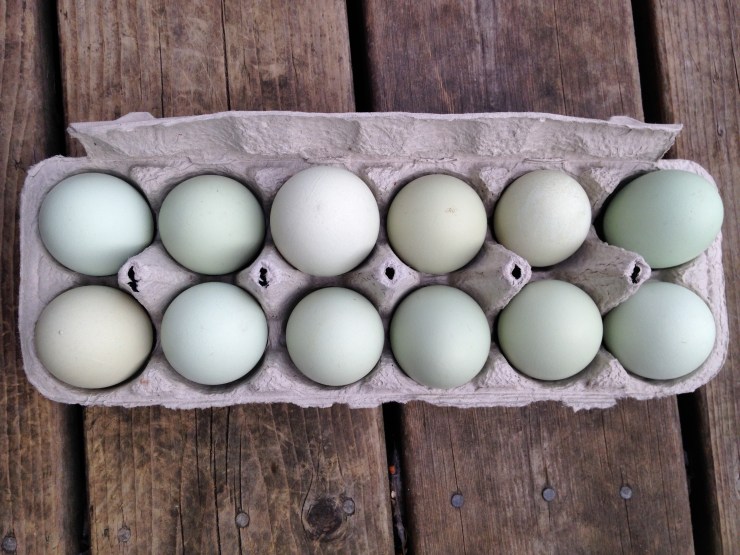
When I got my copy of Happy Hens and Fresh Eggs by Toronto author Signe Langford I judged it, yes judged it, by its cover. Cute quirky name, I thought, guessing this was yet another cookbook on eating local with a beautifully art-directed cover.

HappyHens_RGB300

Wrong.

This cookbook is a keeper.

Continue reading “Happy Hens and Fresh Eggs”

Digging Sweet Potatoes

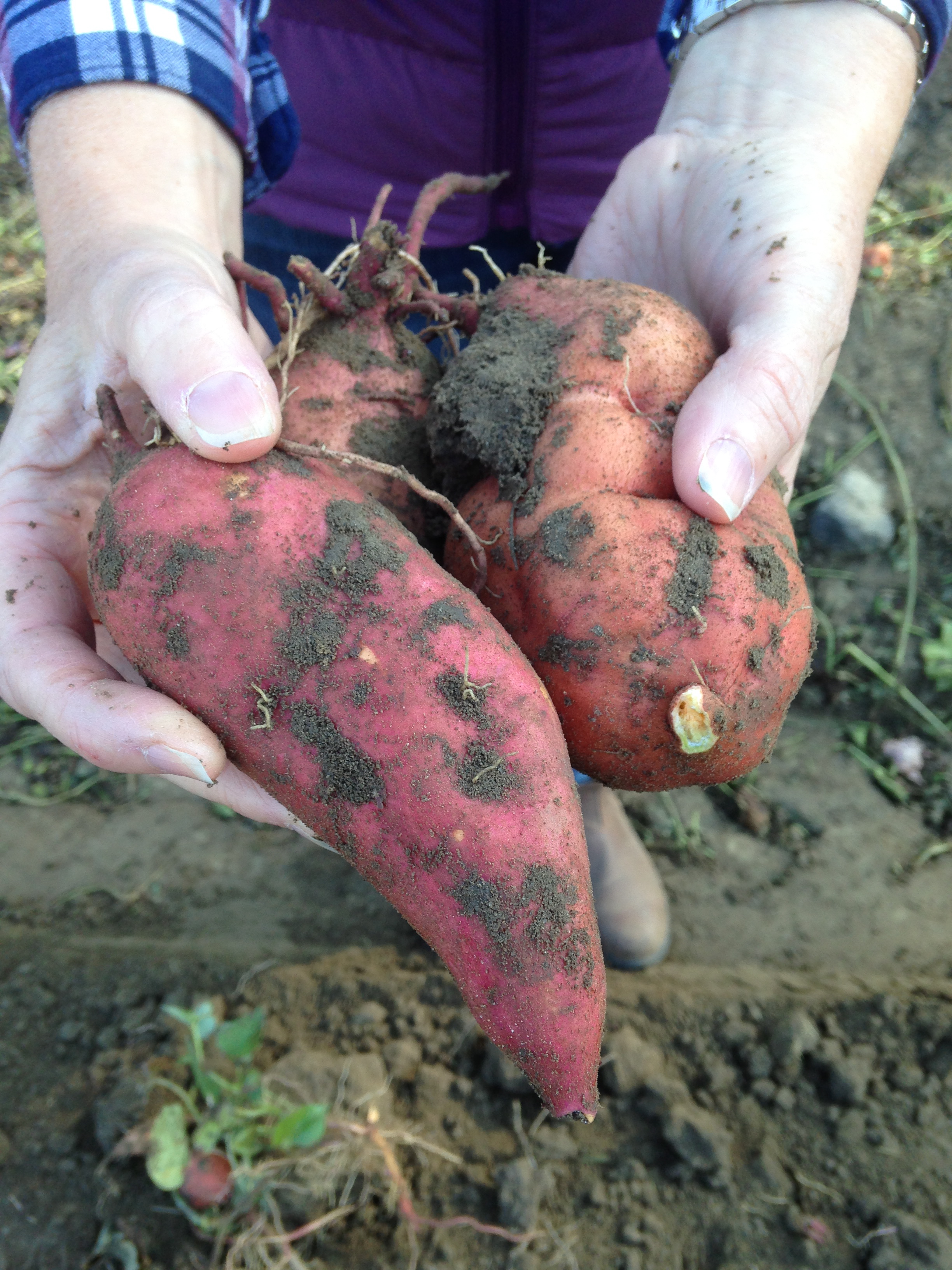
Last week I put on my boots and jeans and boarded one of two, large tour buses heading for a sweet potato farm in Simcoe, Ontario. You’d think the author of a book on fresh produce might know that sweet potatoes grew in Ontario – but she didn’t. And you’d think that the farm we were about to visit might be run-of-the mill, but it sure wasn’t.IMG_4914

Berlo’s Best Sweet Potatoes is the largest grower in Canada, with some 700 acres devoted to the adobe-coloured roots, annually harvesting a whopping 14 million pounds. Right smack in their busiest harvest of the year, head farmer, visionary and CEO Peter VanBerlo Sr. stood at the ready to tour us around his acreage, armed with an amplifier, microphone and 16 years of sweet potato farming experience.

Our bus had travelled from Mississauga to the sandy loam of Norfolk county, one of the most diverse agricultural areas in OntarioIMG_4889Tall and lanky, VanBerlo stood roadside motioning us to park beside one of his sprawling sweet potato fields. Armed with smartphone cameras, pens and paper, our mostly-female group got off the bus slightly dazed and disoriented. City folk, we stumbled an unsteady course through the field, negotiating our way over burrowed trenches and uprooted debris.

Suddenly VanBerlo shouted “Look there!” and pointed frantically at one of his custom engineered digger/harvesters off in the distance. It looked like a travelling assembly line, crowded with over a dozen seasonal workers busily sorting, shaking and tossing an incoming sea of the pinky-red sweet potatoes.

“These workers have been with me for 29 years,”said a satisfied VanBerlo. He paused politely as we let out a collective sigh of approval. “I must be doing something right.”

He is.

VanBerlo and his sons Nick and Peter Jr. have teamed up to take the kinks out of sweet potato farming.  It’s a fussy, temperamental root wrapped in a thin, delicate skin that abhors the cold and demands gentle treatment. Traditional farm machineryIMG_4940 wasn’t up to the job so the VanBerlos designed their own   harvesters, and in 2006 established a state-of-the-art facility.

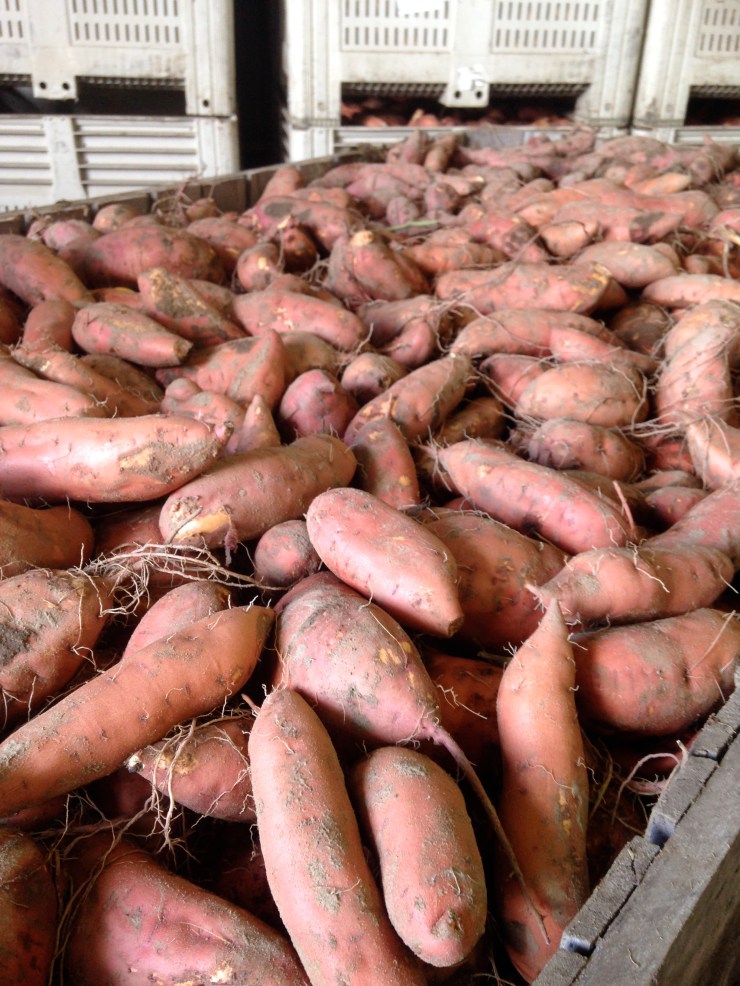
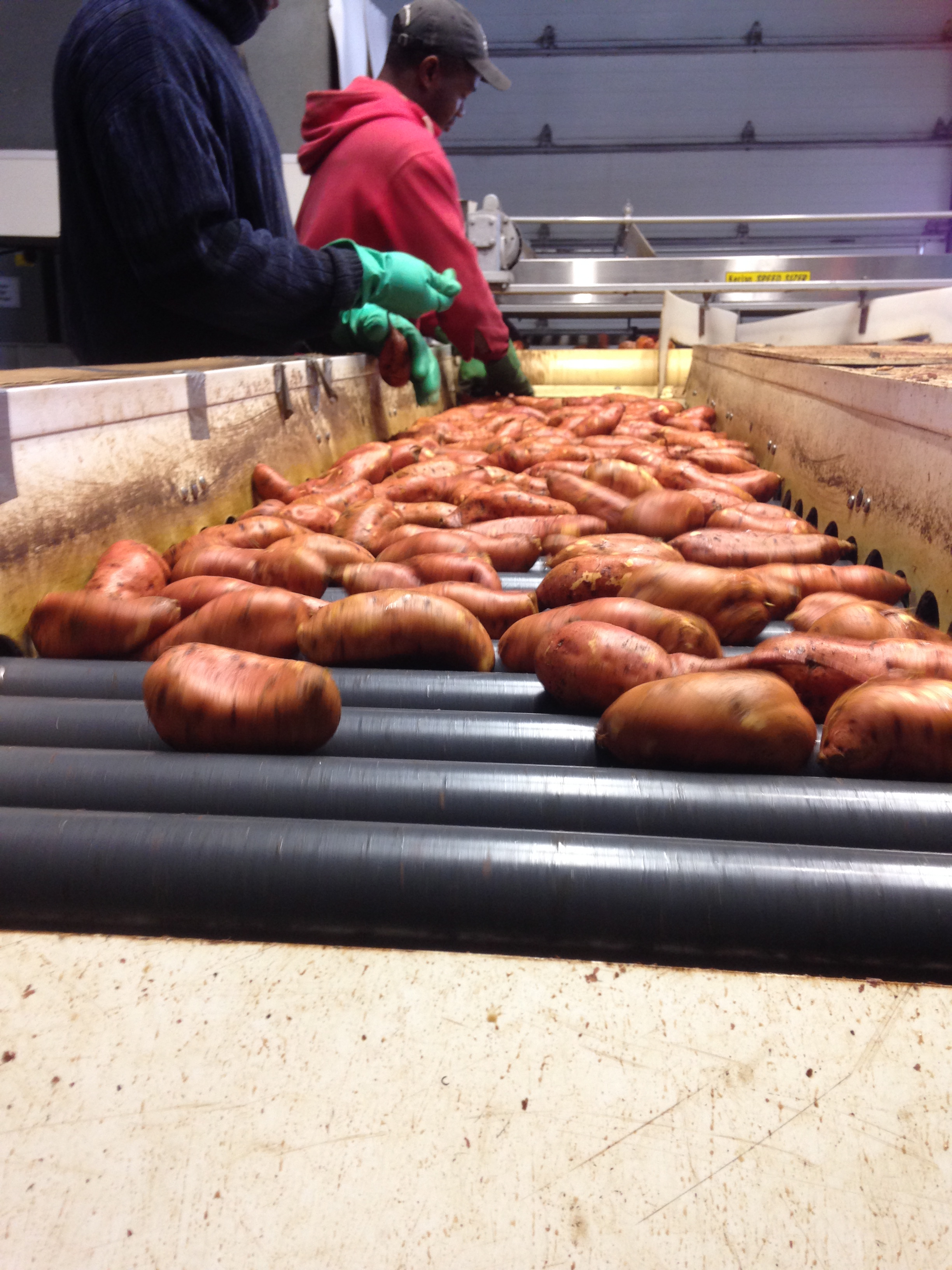
After our romp through the fields, VanBerlo Sr. took us into this gargantuan packing, curing and storage facility to watch employees wash, sort, bag or box the spuds before undergoing their four to seven day curing process.

“Basically we fool these potatoes into thinking it’s summer and time to get growing again,” explained VanBerlo with a twinkle in his eye. “We put them in a hot, humid 85 degree (Fahrenheit) room and their skins thicken and the starches convert into sugars.” Once fully cured, sweet potatoes are stored for up to three months in his computer-controlled facilities that automatically shut off the curing process and turn on cold storage in well-ventilated, 55 degree F rooms that are stacked high with crates from ground to ceiling. It’s massive.

IMG_4943

Curing not only makes sweet potatoes taste better, but it helps promote longer storage. Van Berlo says his sweet potatoes can store for 12 months but once they’re moved out of storage, shelf-life is reduced to a couple of weeks.

At home, store your sweet spuds in a dark, cool cupboard rather than the fridge.  In fact, give them more TLC than you might confer on regular potatoes for if sweet potatoes are dropped or punched around, their sweet interiors will quickly bruise and decay.

When asked about the sweet potato-yam confusion among produce retailers, VanBerlo just laughed and said, “If Sobeys asks for yams, I give ’em yams.” But that’s an inside joke between all of us sweet potato experts. (Real yams don’t grow in North America and look very different: they are white-fleshed, long starch tubers with rough scaly skins.)

Berlo’s Best sweet potato farm bears testimony to the resilience and innovation of  Simcoe’s former tobacco farmers. It’s a one-stop-shop for growing, harvesting and packaging a capricious root from the American south.

Now put that in your pipe and smoke it.

Sweet potato puree with pecans served at Bonnie Health Estate

Sweet potato soup with ginger and cinnamon

Fresh ginger is the magic of this soup.  Peel it and grate with a microplane for best results. If you’ve got a spice grinder, cinnamon is always at its peak when freshly ground.

2 tbsp            vegetable oil

1                       onion, chopped

2 tsp                 finely grated fresh ginger

4 cups               low-sodium chicken stock

3 lbs (1.5 kg)     medium sweet potatoes (about 5),                                                                                      peeled and cut into half-inch (1 cm) dice

1 tsp                    ground cinnamon

1 1/2 tsp             salt

Freshly ground pepper, to taste

1 cup                     milk or cream

In a large pot, heat oil and cook the chopped onion at medium low for 5 minutes or until soft and fragrant. Add  ginger and cook for 30 seconds. Add stock, sweet potatoes, cinnamon, salt and pepper. Bring to a boil then reduce to a simmer and cook, covered, for 15 minutes or until the potatoes are tender. Remove soup from heat and allow to cool. Use a handheld immersion blender or puree in batches in a blender or food processor. Gently reheat and whisk in milk.

© 2015 Madeleine Greey


Pesto Perfect

It’s August and I’m dipping fingers and bread into a bowl of freshly made pesto. The colour shimmers emerald green and licorice notes of sweet basil jump into my nostrils, the garlic-tinged oil making a smooth slide down my throat.

IMG_4022I want to eat it by the spoonful, but instead rush to store it before the colour and flavor are ruined by oxidization. So off it goes, portioned into small, glass jars covered by a thick layer of oil, lidded and refrigerated. I will slather it on warm toast, piling on sliced garden tomatoes and crisp bacon to make daily BLTs to be consumed with lascivious abandon. A teaspoon or two will find its way into homemade salad dressings, more will be drizzled over grilled shrimp and sometimes I’ll float a coin-sized island of it in the middle of a creamy cold cucumber soup or smear it on crostini with grilled veggies.

Continue reading “Pesto Perfect”

The rub on spices

Decades ago, I warned Toronto Star readers in my “Taste of Asia” column to throw out any ground spices and herbs in their cupboards older than six months. I said they were past their prime. Defunct. Bad stuff.

No one likes a bossy food writer, so I tried to soften the tone and replace visions of global spice carnage with a gentle challenge: Close your eyes, open a random bottle and take a whiff.IMG_2593

“If you can’t smell anything, toss it,” I cajoled.

Well, I’m still on a spice rant after all these years. Commercially dried and ground spices and herbs lose most of their je ne sais quoi the moment they are harvested and processed, for it is at this juncture that their flavour-filled essential oils begin to degrade.

It gets worse.

When herbs and spices are ground into a powder, they are exposed to the ravages of oxidization and time… especially if they fall into obscurity in a deranged spice drawer like mine.

Luckily, mine underwent a radical makeover last week. I threw out all the wizened and yellowed dried red peppers, aroma-less ground powders of dubious distinction and the contents of any package, bottle or tin box that landed in said drawer prior to 2015 – with the exception of nutmeg.IMG_2545

I’m the proud owner of some relatively ancient nutmeg nuts, encased in shells and decorated with a fancy filament of mace. They come from Grenada and I began to horde them after several culinary visits to the Spice Island of the Caribbean. Alas, these nutmegs have broken all my self-imposed “Spice and Herb Guidelines”. They demonstrate incredible flavour once I hack off the shell with the blunt end of a knife and finely grate with my Cuisipro rasp.IMG_2586

The places this nutmeg goes! Sometimes it’s just a sprinkle over a Grenada-style rum punch. Or, a teaspoon into garam masala bound for a Punjabi-style curry. So alive are my nutmeg relics that a taster at my table recently detected a single smidgen slipped into a creamy, rich Yukon gold potato gratin.

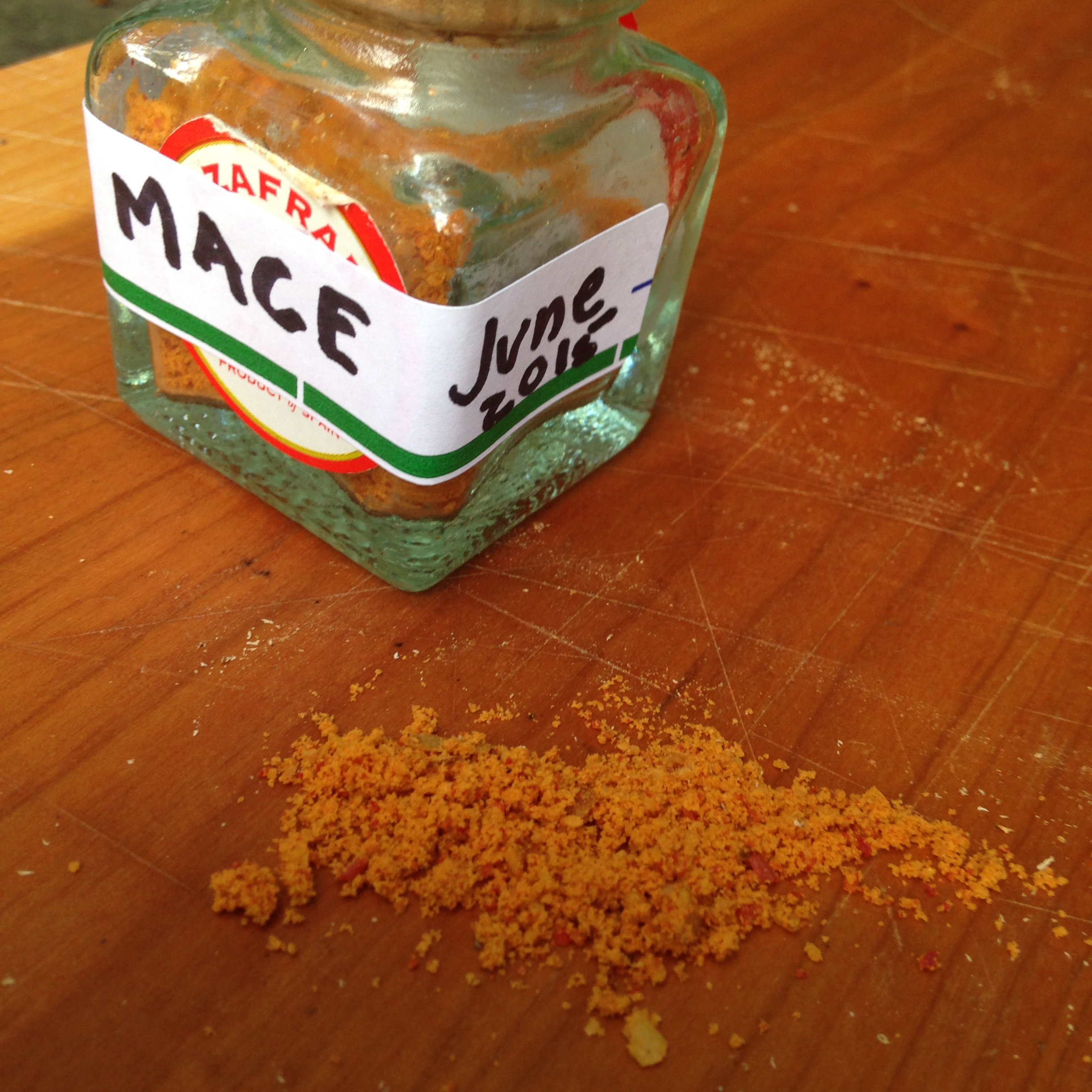
Despite an undeniably close connection to the ever-popular nutmeg, mace is one loner of a spice. It boasts a well-known affinity with pumpkin, but just doesn’t seem to pop up on the recipe radar otherwise. You can imagine my glee, when I stumbled on a rub recipe calling for a whopping teaspoon of the stuff. I had some whole mace at my fingertips and was ready to put it through the grinder.

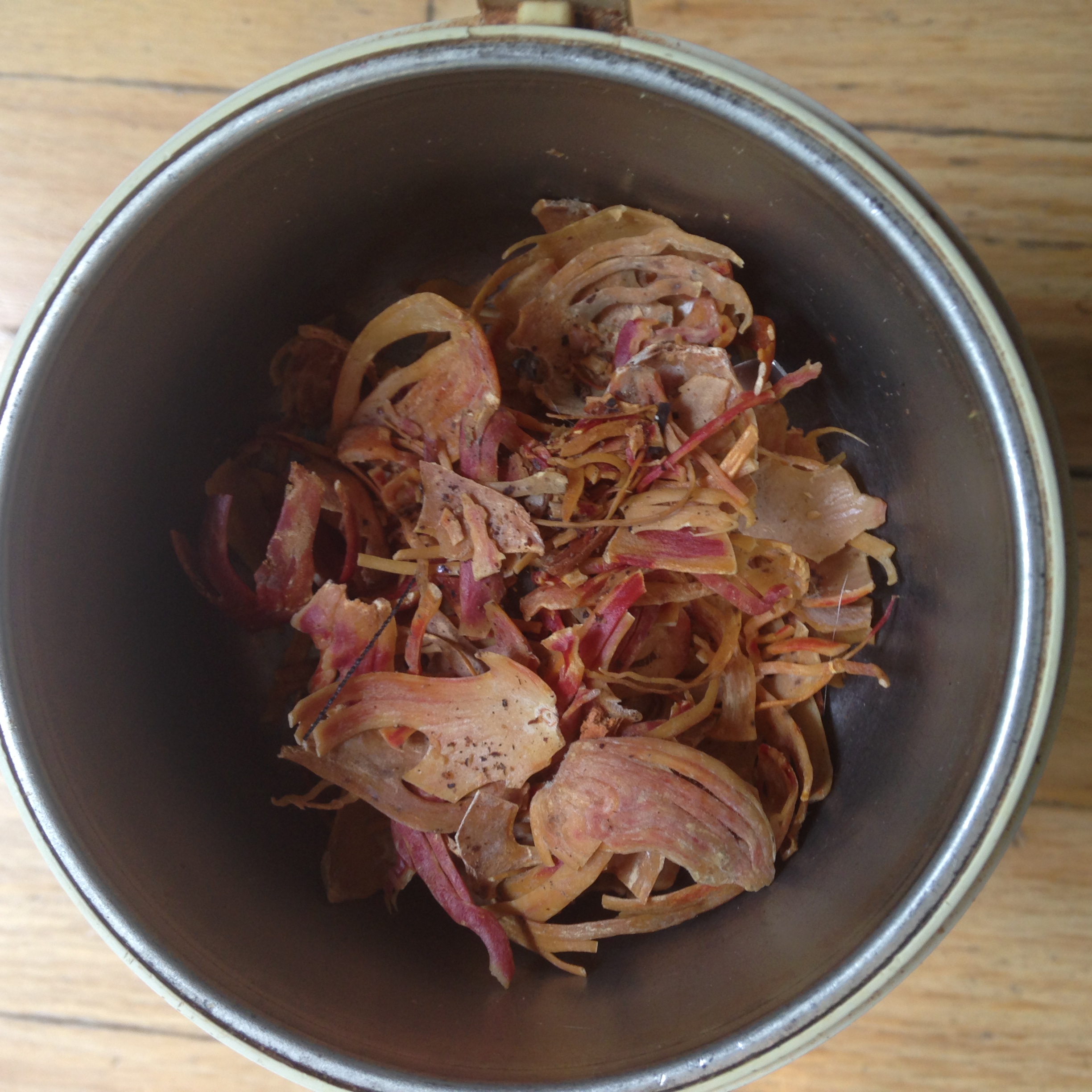
IMG_2545I simply peeled the lacy filaments off my whole nutmegs and placed them in my trusty spice blender that has continued to get revved up over all the cumin, cinnamon, cloves, cardamom (green and black), peppercorns, hot peppers, coriander, all spice, fennel and fenugreek I have been feeding it for the past three decades.

In went the mace filaments and out came a surprisingly pumpkin-toned powder that tasted more pungent and citrusy than its soul-sister nutmeg. When I closed my eyes and did a side-by-side sniff of the two, it was difficult to tell them apart. No wonder McCormick spice’s web site suggests putting either one in many of the same destinations, be it custards, eggnog, spice-filled quick breads or dusted on steamed veggies like carrots or sugar snap peas.IMG_2546IMG_2550

Back to the rub, which I spotted in my beloved Joy of Cooking but as per usual, put my own riff on. I chose it not only for the mace, but all the roasted cumin and cracked peppercorns.

Admittedly, cumin is my favourite. Sometimes I grind it raw, but I’m more apt to first toast the seeds in a dry frying pan over medium heat until they start to smoke. (Dry-frying spices is a risky venture as there’s a fine line between browning and burning. It helps to keep a sample of raw cumin seeds nearby as you dry-fry, to offer a visual comparison.) I like to grind the cumin seeds while they’re hot so as to savour the hot cloud of nutty cumin smoke released when the lid comes off.

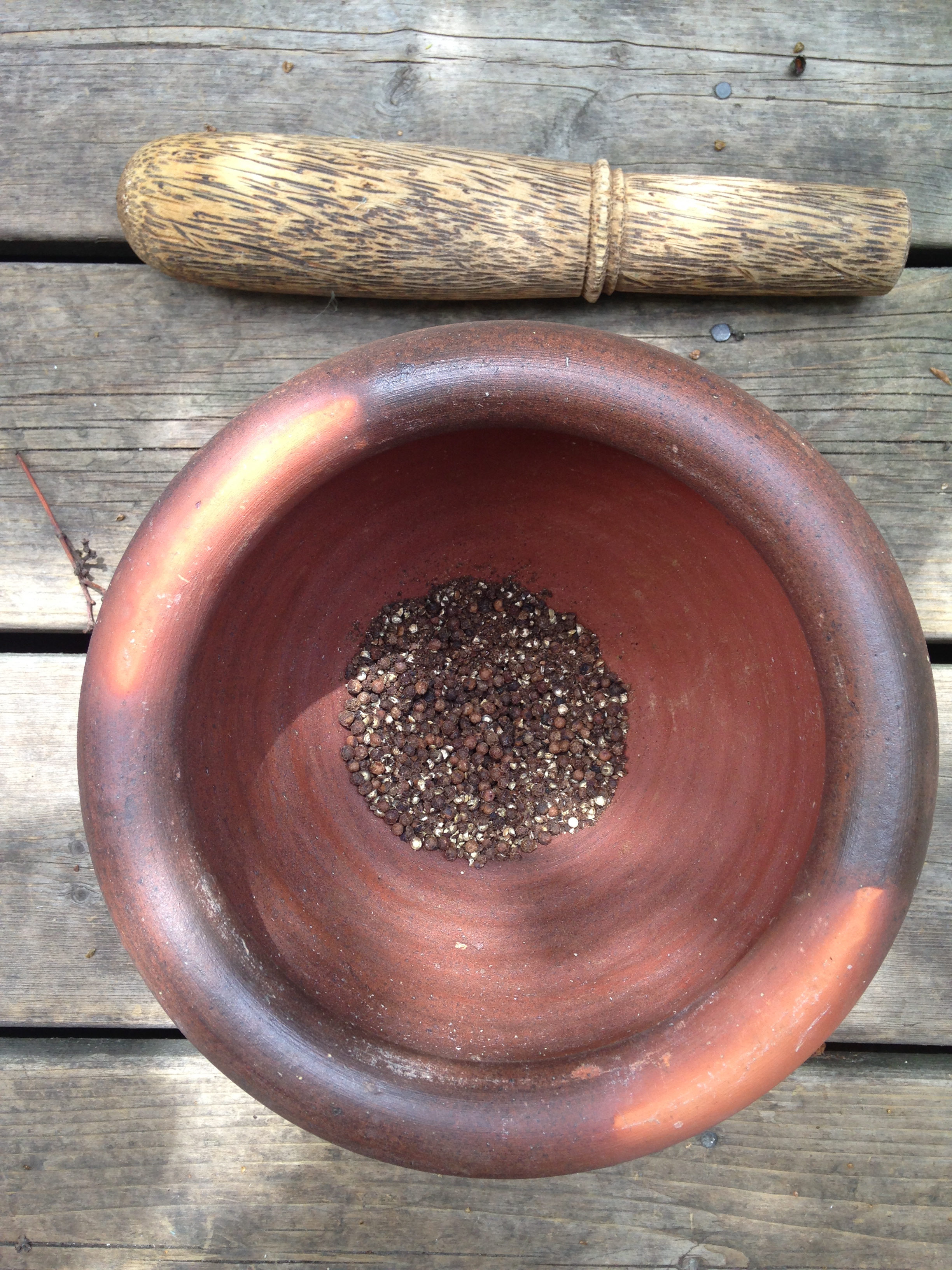
IMG_2554I used my Thai mortar and pestle to crack or coarsely grind the black peppercorns used in this rub. To add authenticity, I took my hulking mortar outside, placed it on my back deck and visualized the northern Thai town of Fang where I saw countless fine cooks squat and pound – a satisfying way to approach this kitchen tool and more effective than placing it on a kitchen counter.

IMG_2542

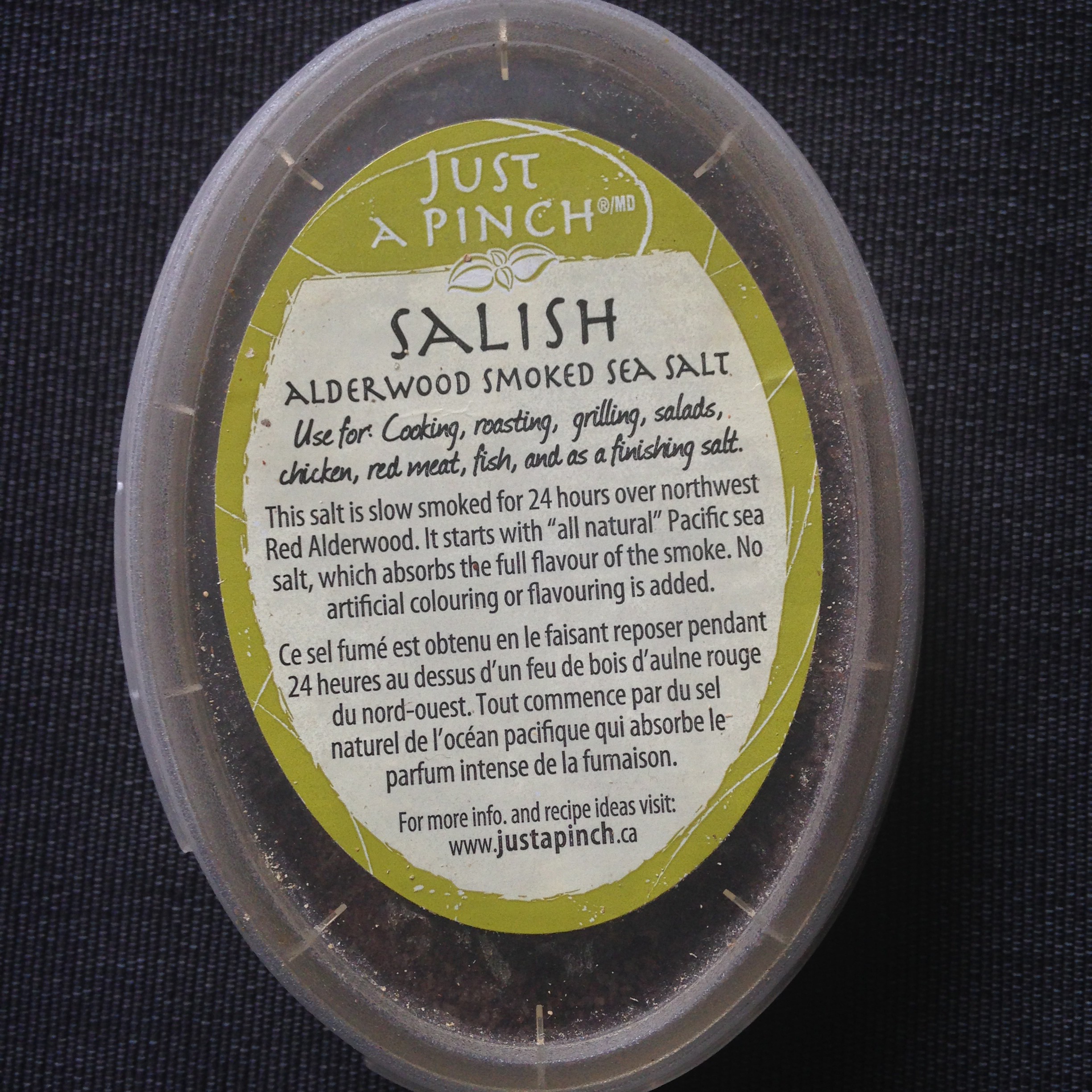
Last but not least, salt. If you like smoky flavours, check out Salish, an Alderwood smoked sea salt.


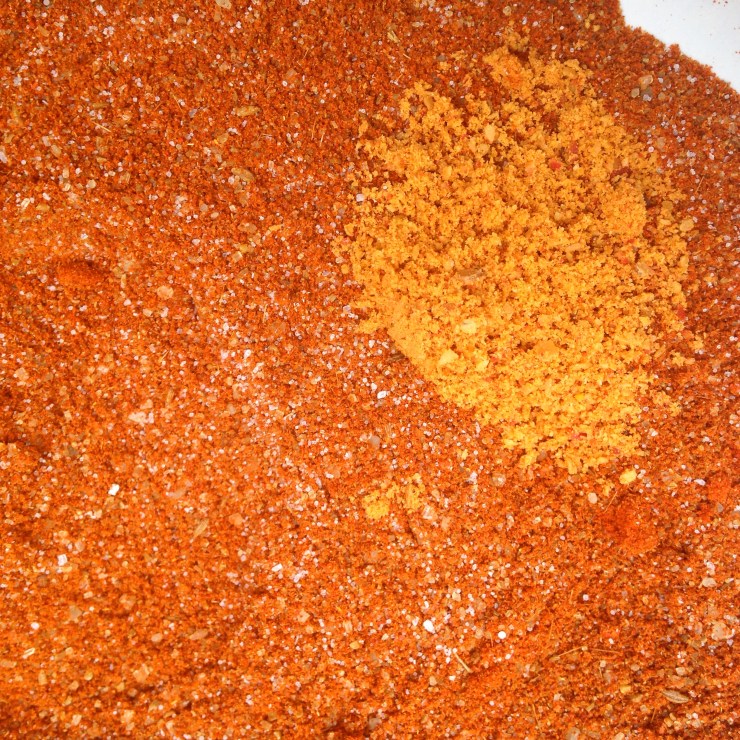
Smokey, toasty pork rub

Get out your spice grinder and have some fun concocting this gorgeous mixture. Whole nutmeg nuts can be found in Kensington or St Lawrence Market or Little India. Try this on grilled pork chops, baby back ribs or slow-cooked pork shoulder. Rub one tablespoon per pound just prior to cooking or better still, rub and refrigerate overnight.

½ cup sweet or smoked paprika

¼ cup ground roasted cumin

¼ cup packed brown sugar

¼ cup cracked/coarsely ground black peppers

2 tbsp hot cayenne powder

2 tbsp sea salt

1 tbsp chile guajillo molido (or any mild chile powder)

1 tbsp smoked salt

2 tsp mace

© 2015 Madeleine Greey

IMG_2564


My mango mania

I met my first mango in Taiwan in 1980 and it was love at first bite.  Like so much for me in Asia then, a mango was terribly exotic and new. I was floored by its fresh, juicy, tropical taste and loved eating it “inside out”,  those luscious orange cubes popping out from a leathery,  inverted skin.thai20ice

Mango orchards covered much of Taiwan and small mountains of these fruits used to fill the markets during mango season. On a student budget, this was something I could afford to binge on, but my Chinese Auntie was appalled by my ravenous appetite.

“Too much yang,” she’d scold, wagging a finger. “This fruit is too yang. It’s  too hot!  It’s going to make you sick.”

It didn’t.

I know that Chinese notions of dietary, yin-yang balance are centuries old and very wise but when mango season comes to town, I open wide and gobble up.

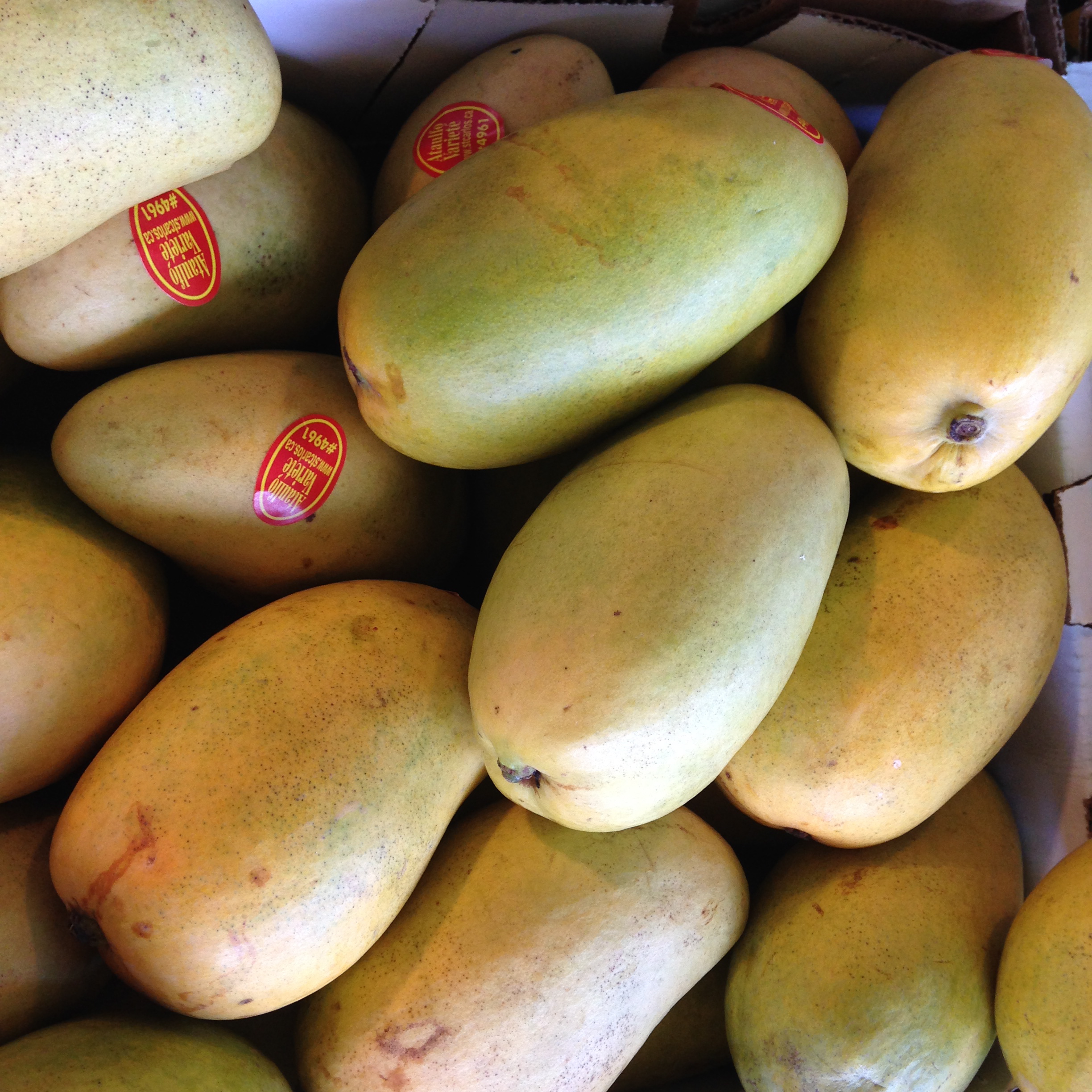
IMG_1704Every spring in Toronto these yellow, kidney-shaped mangoes called Ataulfo and Alphonso start to appear and I can’t wait to peel off their skin and slice into their rich golden, fibreless skin. Deeply sweet and intoxicating, it’s no wonder Persians named it samarbehist or fruit from heaven.

I’m happy to eat it straight for breakfast, or slice it up and toss it into a fruit or green leafy salad. It goes into my Thai mango salad and stars in a salsa (recipe below). Sometimes I’ll cook up some coconut sticky rice and serve that adorned with thin slices of mango. Nothing beats it pureed into a mango lassi or strawberry smoothie.

Besides rocking in the taste department, mango is a nutritional powerhouse, ranked right up there in the top ten list of good-for-you fruits. It’s an excellent source of vitamin A, high in C and a source of fibre, vitamins E and B6. Moreover, it’s bursting with carotenoids (plant pigments) such as beta carotene and zeaxanthin, which protect against cancer, enhance immunity and help to prevent age-related macular degeneration, the leading cause of blindness.

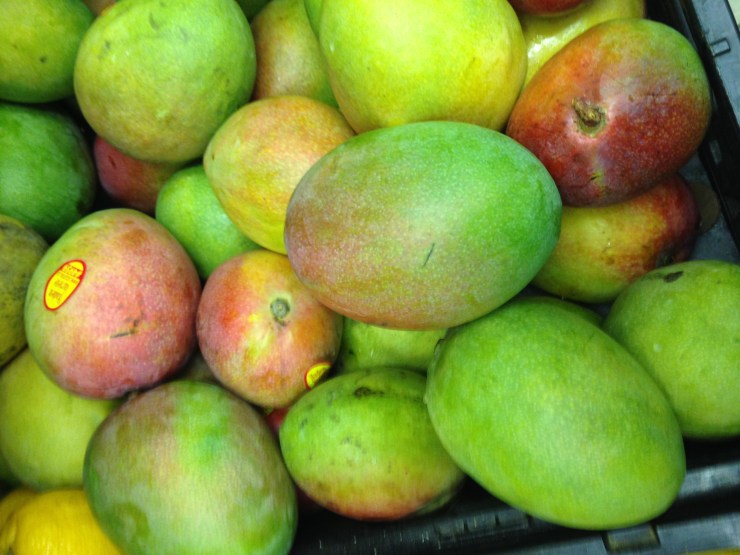
Before Ataulfo and Alphonso entered the market, most consumers were familiar with Haden, Kent or Tommy Atkins mango. These are oblong or roundish, about the size of an adult hand, covered in green skin splashed with red and sometimes yellow patches. They usually weigh about twice that of the smaller yellow ones.

IMG_1711It’s good to know that colouring does not indicate ripeness in a mango. How it feels, does. A ripe mango should yield to slight pressure and have the feel of good leather. Sniff around the stem end. A ripe mango will emit an intense, flowery smell.

Two new varieties of mango have become available, the big green Keitt from the USA and the Pango Mango from Puerto Rico. Both are large meaty mangoes. The Keitt stays green, even when ripe.   And the newly developed green Pango Mango with its reddish blush has no fibre at all.

MANGO SALSA

Serves 4

_MG_9552-EditEdit

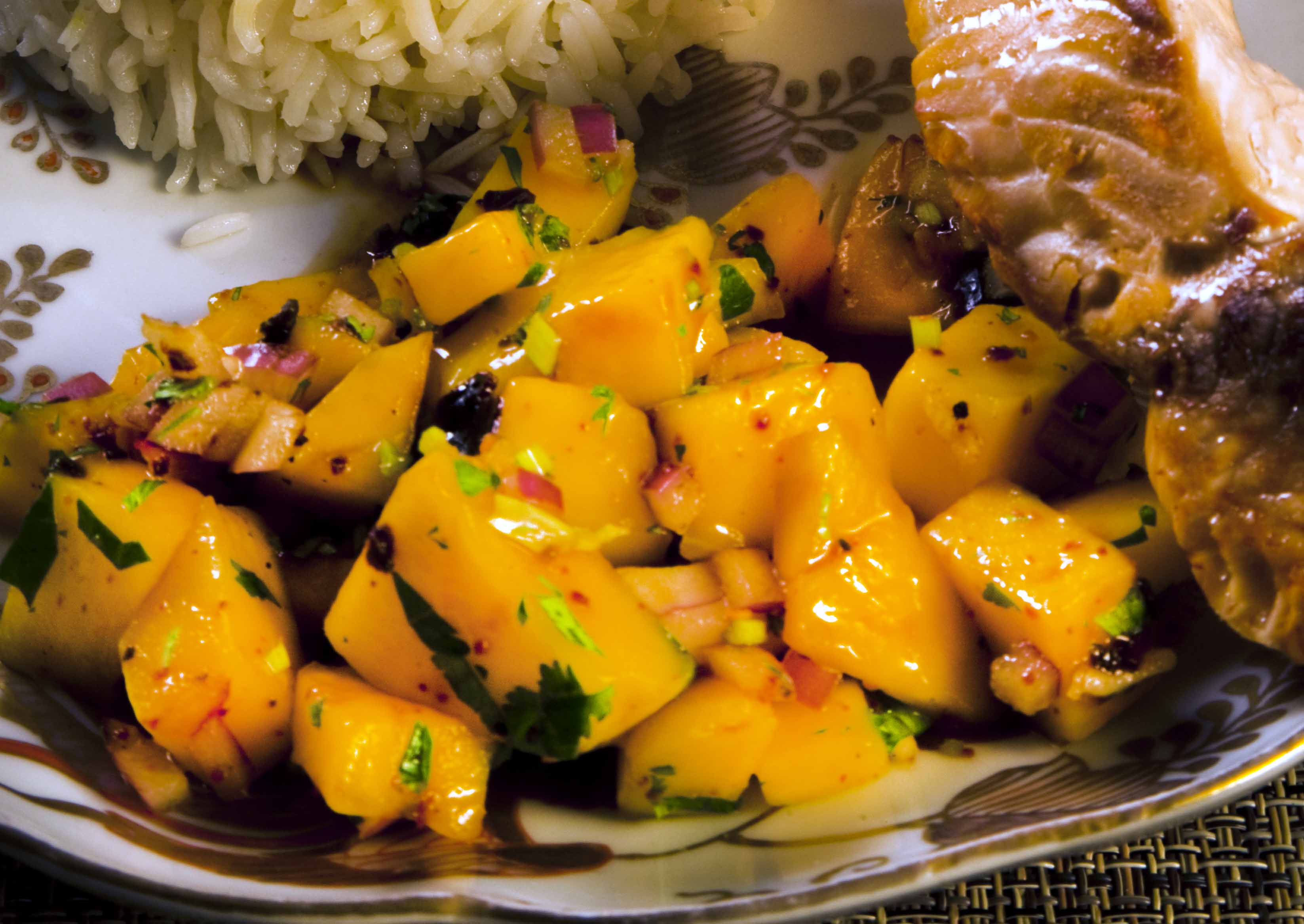
This salsa offers up a quartet of flavours: sweet, sour, salty and hot. It’s a cinch to make and, like most salsas, the flavours intensify if you let it sit in the fridge for a few hours before serving. Mango salsa is the perfect counterpoint to grilled poultry or fish, Tex-Mex dishes or even curry served on rice. Be sure to use fully ripe mangoes.

2 ripe mangoes, peeled and diced into 1/4-1/2-inch cubes

1/2 cup            chopped red onion

1 clove garlic, crushed

1/4 cup            chopped fresh coriander

Juice of 1 +1/2 limes

2 roasted sweet peppers   * optional

1 large dried hot pepper, dry-roasted

Salt

In a non-metallic mixing bowl, add the mangoes, red onion, garlic, fresh coriander and lime juice. Dice roasted red peppers if using and add to mixture. Chop dried chili pepper and add to salsa mixture. Salt to taste. Refrigerate for at least 1 hour before serving for best results.

 Dry-roasting your dried chili peppers helps brings out richer flavours.   Plus, it’s simple to do. Either roast it in a dry frying pan at medium heat for a few minutes or until it turns dark brown, or roast it in your toaster oven. It’s easy to burn a dried red chili pepper, so watch it carefully.

Dress it up

My niece Katie loves salads. I think she likes to crunch through one every day, if not every lunch and dinner.

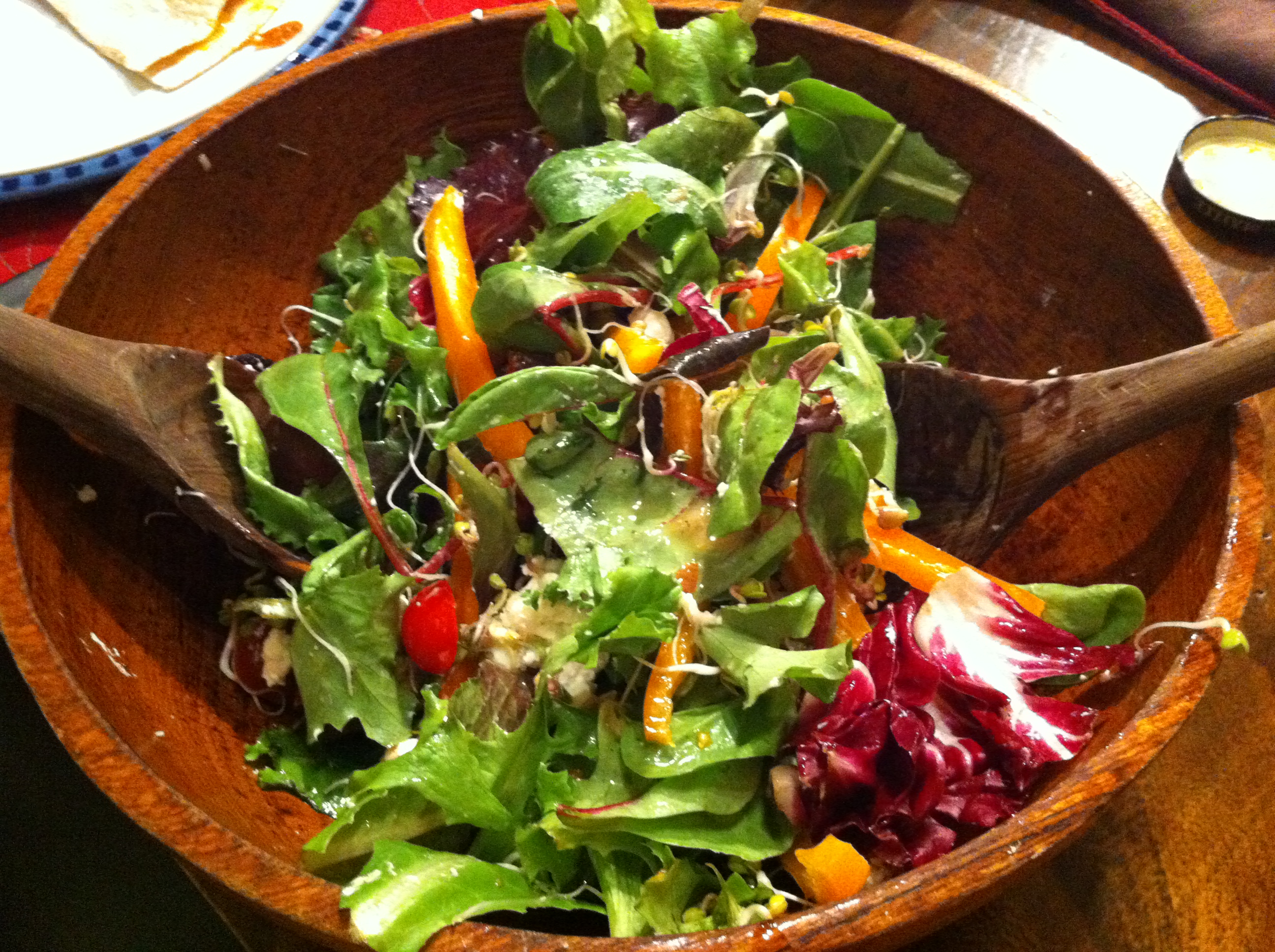
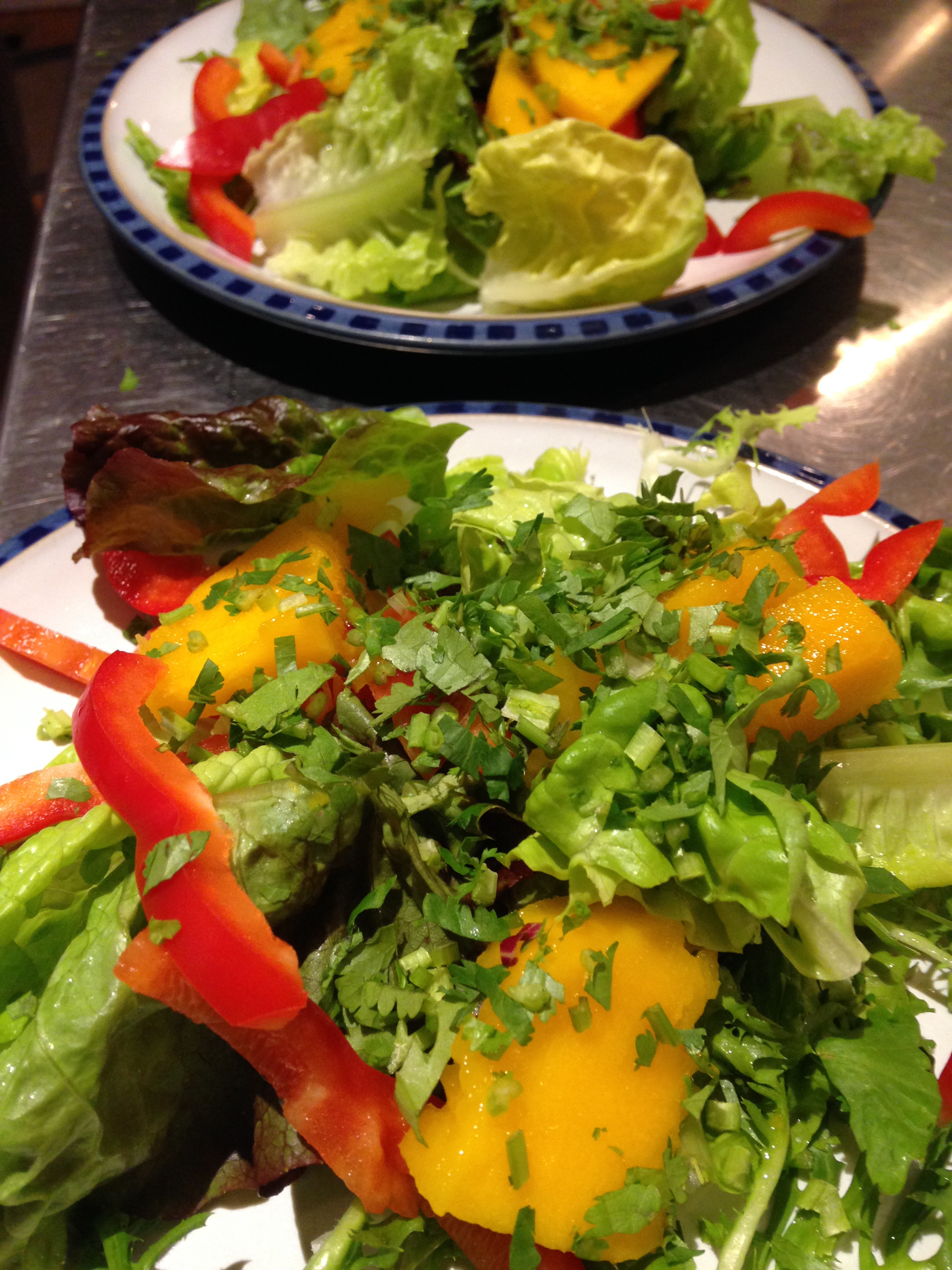
Last Sunday, I served her a mix of red and boston lettuces, frisée, sunflower sprouts, sliced mango, red peppers, and lots of chopped fresh coriander. IMG_6801

She liked it and gave me further compliment by asking, “What’s in the dressing, Aunt Maddy?”

I get asked that a lot and am shocked that more household fridges aren’t crowded with as many little jars of homemade vinaigrettes as mine – especially when you taste the difference between your own creation and some lousy, store-bought facsimile.

Here’s the basic template, which starts with an empty lidded jar.

Fill it with this:

IMG_77811 shallot, finely chopped

½ tsp Dijon mustard

1 tsp maple syrup

2 tbsp red wine vinegar

½ cup extra virgin olive oil

Big pinch salt

Freshly ground black pepper

Screw on the lid and make sure it’s on tight so you can shake it like crazy (a.k.a. emulsify). Before you pour it on a salad, dip in a tasting spoon or a leaf of lettuce and taste it. Consider if you’ve got the balance right and add a little bit more oil, seasoning, sweetness or acid to find the exact flavour you are looking for.

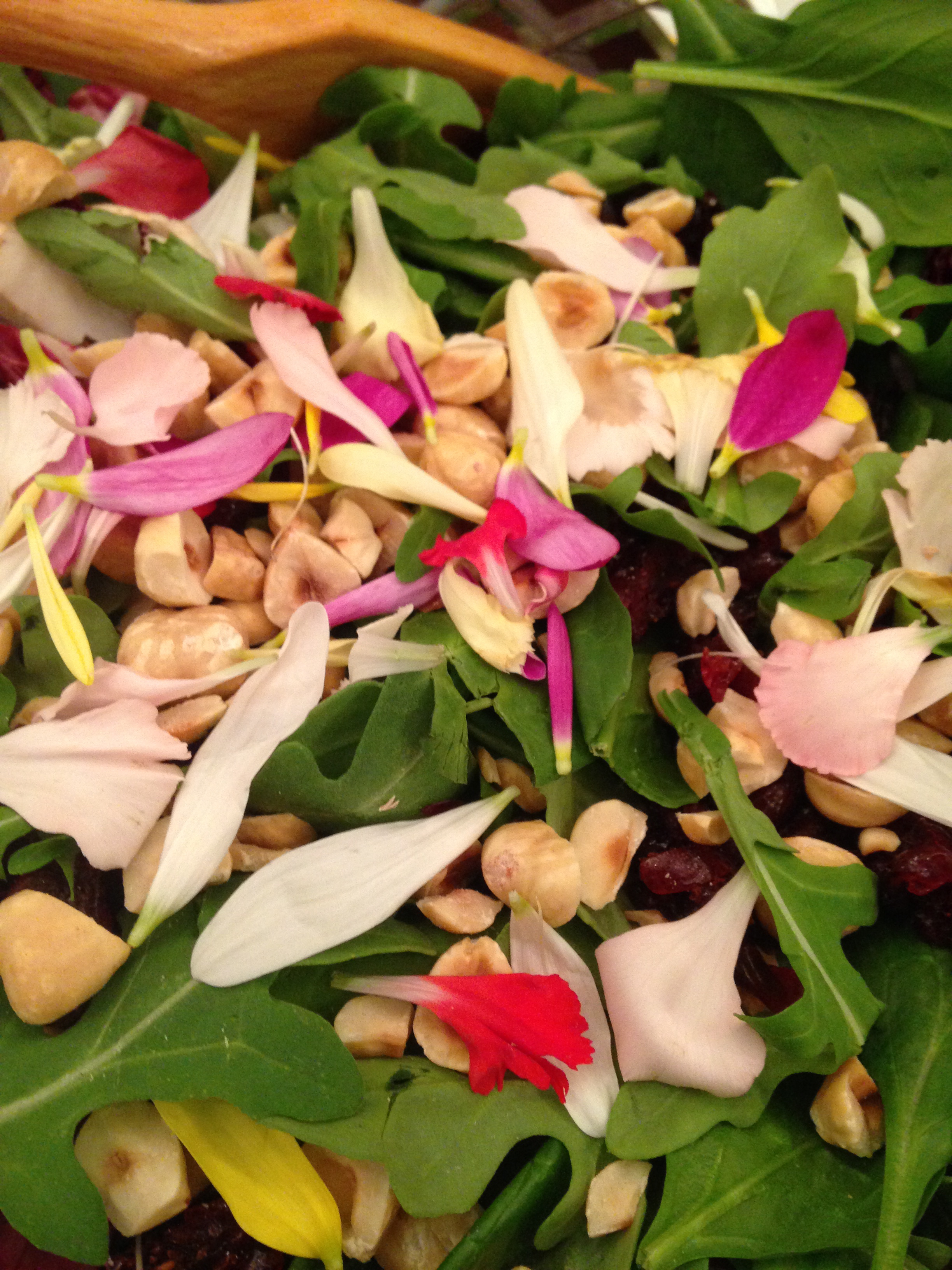
Making vinaigrettes and salad dressings is a great place to flex your culinary muscles and develop your palette. The contents of your fridge and cupboards are your personal playground and it’s time to start romping through it, pouring, mixing and tasting.Flowerpetalsalad

Abide by a simple rule. Add one part souring agent (be it vinegar, citrus juice, pureed fruit, yogurt or even tamarind) to four parts oil. If it has too much pucker power, you can dilute it with more oil. Sometimes all it takes is a little sugar, honey or maple syrup to balance things out. While it is called a vinaigrette you don’t want it to taste too sour.

Watch out for lemon and lime juice. Both are potent additions compared to their milder cousins, grapefruit and orange.

Vinegars vary in acidity too. That’s why many salad lovers like the sweet, subtlety of balsamic over the bludgeon power of white or cider vinegar.

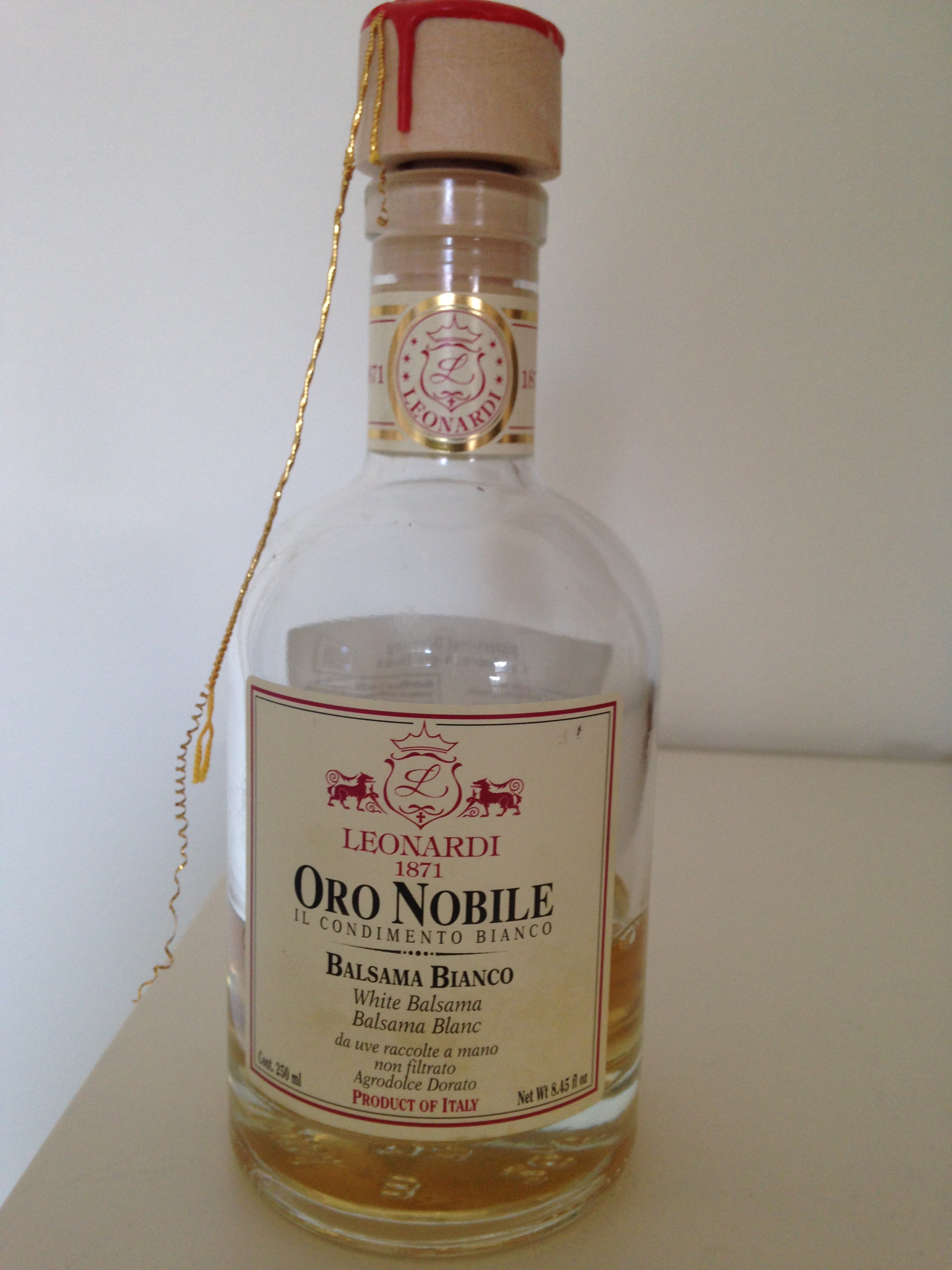
Leonardi Oro Nobile IMG_1817is a white balsamic produced using white grape must. It has a fruity, mildly acid aroma that will caress any vinaigrette into a work of art. I bought mine at Olive and Olives, a fine olive oil emporium that suddenly closed its Queen St East and Market St Toronto locations last month.

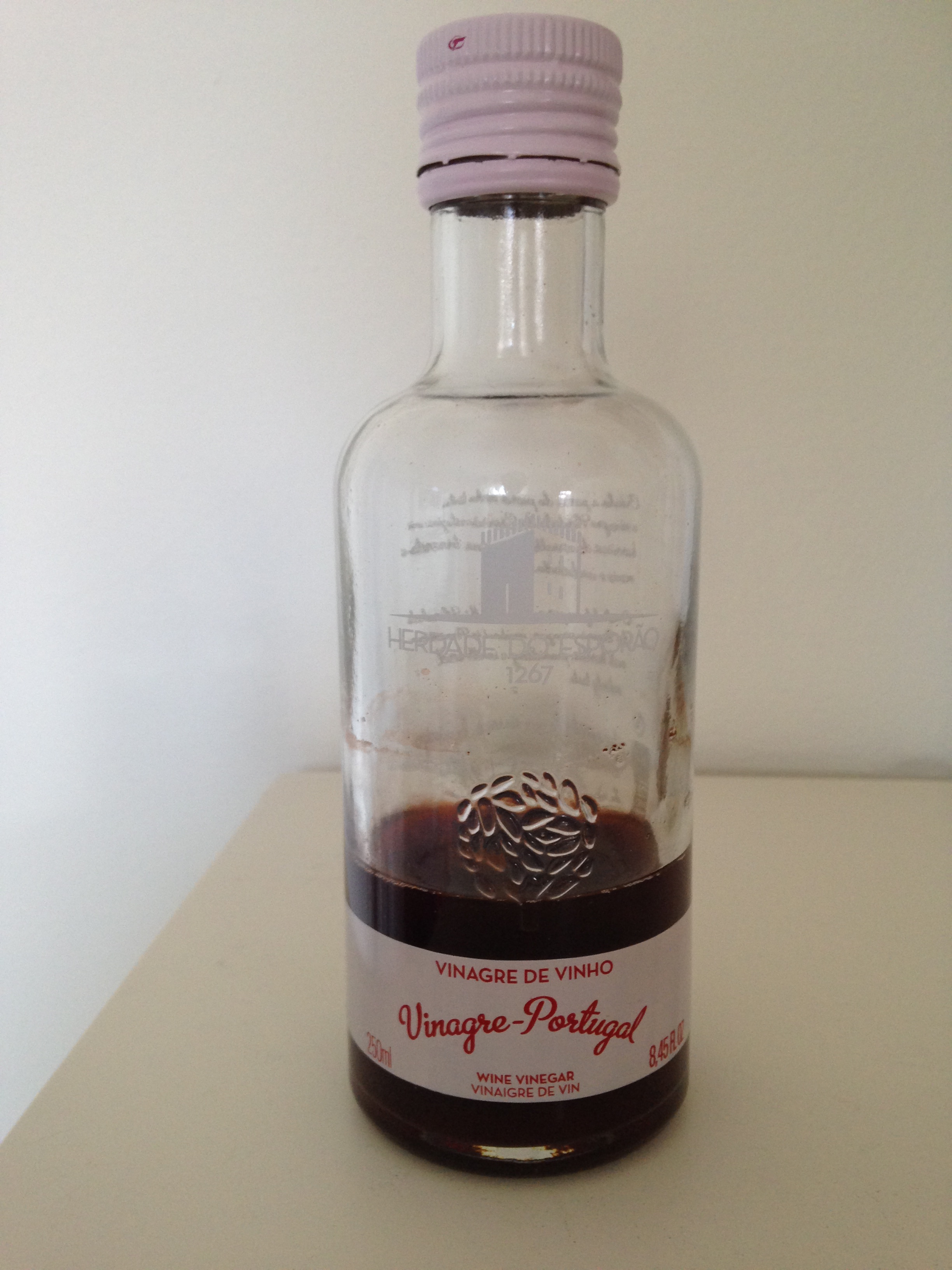
IMG_1816Another of my current favourites is a Portuguese red wine vinegar produced by Herdade do Esporao. I’ve found it at Metro stores.

Extra virgin olive oil is the first oil I turn to for my basic vinaigrette. It has a rich, definable flavour compared to canola, sunflower and safflower which offer a clean slate to build more flavours upon. If you’re making something fruity, like a raspberry or mango dressing, turn to these. Ditto for a spicy dressing with cayenne or chipotle.

Nut oils, like walnut or hazelnut, offer a rich deep flavour that can dominate so add just a little, say a quarter, to the overall oil content. Nut oils beautifully temper bitter greens like arugula or endive.

Shallots offer a great base, since their flavour sits halfway between onions and garlic, the latter which easily overwhelms a dressing.

IMG_1818I find herbs never add as much punch to a vinaigrette as I’d like and rather than pour over the greens gracefully, they clump. But I’d never say no to finely chopped chives, especially now, as they poke out of the spring soil and are as sweet as sin.

Make a vinaigrette this week. I hope Katie does.